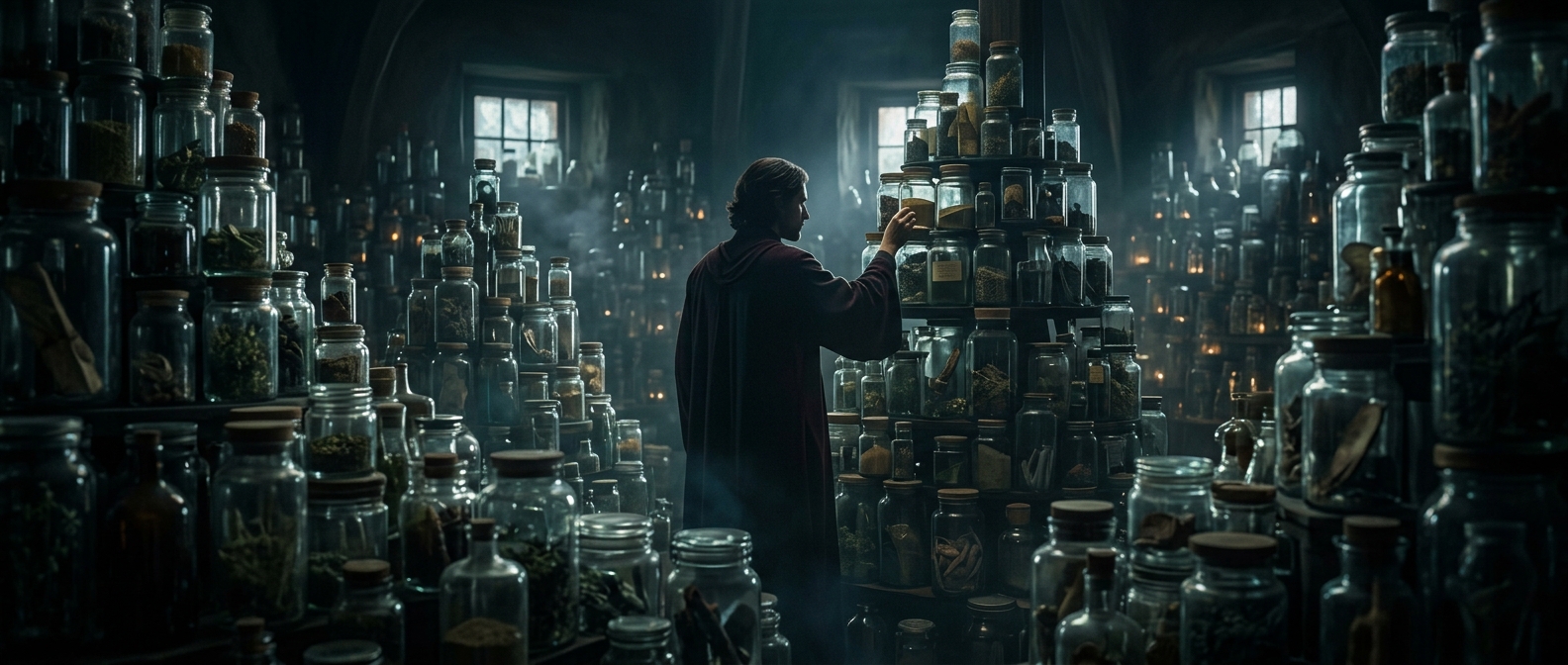
Why the jars multiply
A collection of jars can become a quiet archive of a practitioner’s experiments. Dried leaves, small twigs, and powders are separated and stored so they can be recognized, handled, or used later. Clear glass makes the contents visible, while a lid helps keep out moisture and household dust—useful for plant material that is meant to stay dry.
Storage gives materials a second life
Keeping ingredients on hand turns gathering into preparation: a leaf collected in one season may be saved for a ritual, a craft, or a personal practice months later. Different materials can look alike once dried, so containers also help keep them apart. Labels can identify what is inside; without them, color and shape may be the only clues.
That system has a human weakness. A jar can outlast the moment when its contents were gathered, and the person who knew why may forget—or someone else may inherit the shelf without the explanation. The container preserves the material, but not necessarily its meaning.
The shelf becomes its own kind of record
Over time, jars can hold more than ingredients: they reflect past interests, plans, and experiments, including ones that never reached a clear conclusion. A forgotten powder is not automatically evidence of a secret purpose; sometimes it is simply a remnant whose label or context has been lost.
That is the small irony of the collection: glass makes the contents easy to keep in view, yet a neatly preserved jar can still become a mystery.