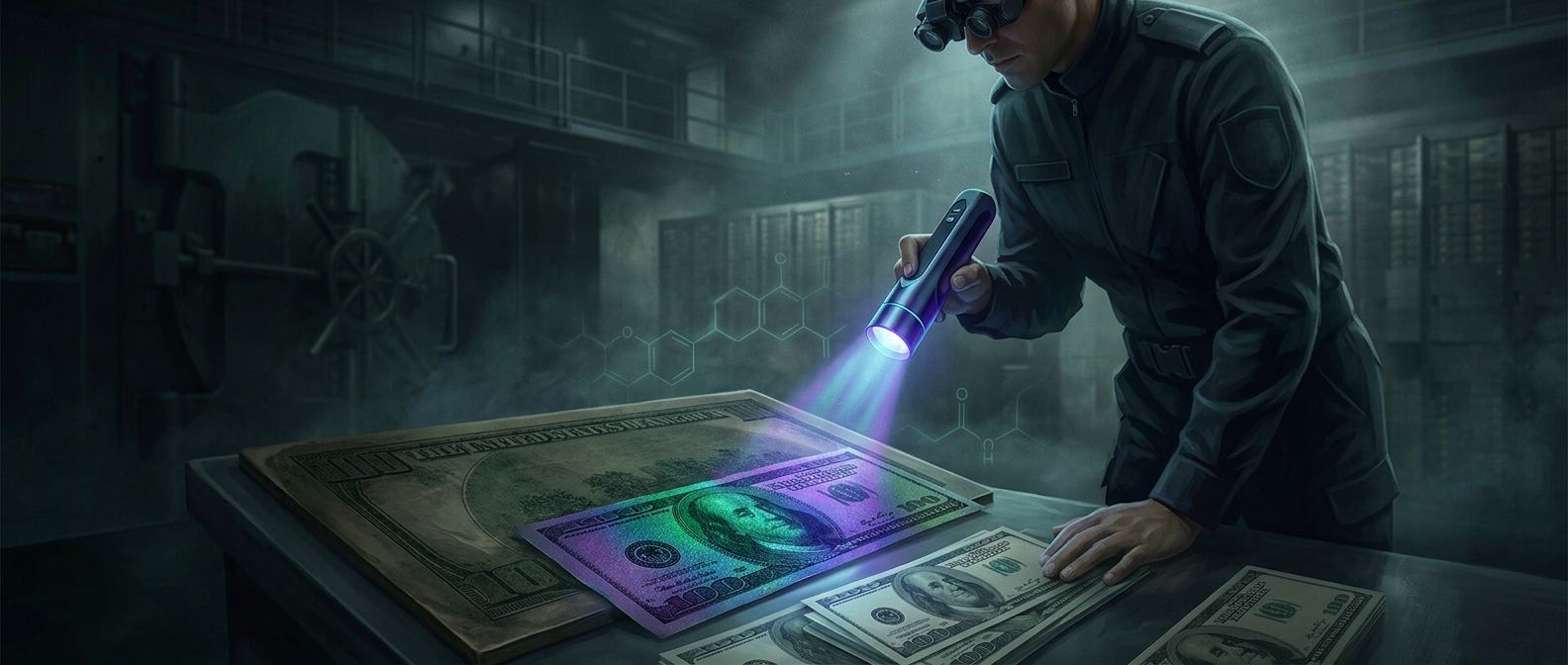
A pattern that doubles as a warning
The EURion constellation is a recurring arrangement of small circles printed on some banknotes. Its dots are easy to overlook when you handle a bill, but they stand out in a scanned image: a machine can compare their positions and spacing with a known pattern rather than trying to decide whether the whole picture “looks like money.”
That makes the feature useful as a signal to imaging software. When a copier or scanner detects a likely banknote, it may refuse to capture the image, stop the job, or prevent the resulting file from being printed. The exact response depends on the device and its software.
Detection without reading the whole bill
A detection system can look for repeated shapes and relationships among them, much as a filter spots a familiar visual motif. It does not need to identify every detail of a note—such as its portrait, denomination, or country—to flag a suspicious image. This is one reason a small, repeated feature can have a practical effect even when it is not prominent to a person.
The constellation is not the only way devices can recognize currency, and not every banknote carries the same visible pattern. Imaging systems may use additional clues, while banknotes also rely on physical security features intended to be checked on the note itself.
A quiet obstacle to easy copying
The system is designed to make ordinary copying and scanning less straightforward, not to make every image of a banknote impossible. A printer’s refusal is therefore a software response to a detected pattern, not proof that the device has established what the note is or whether it is genuine. A few tiny circles can be enough to change what happens next: the machine treats the image as currency and interrupts the routine copy job.