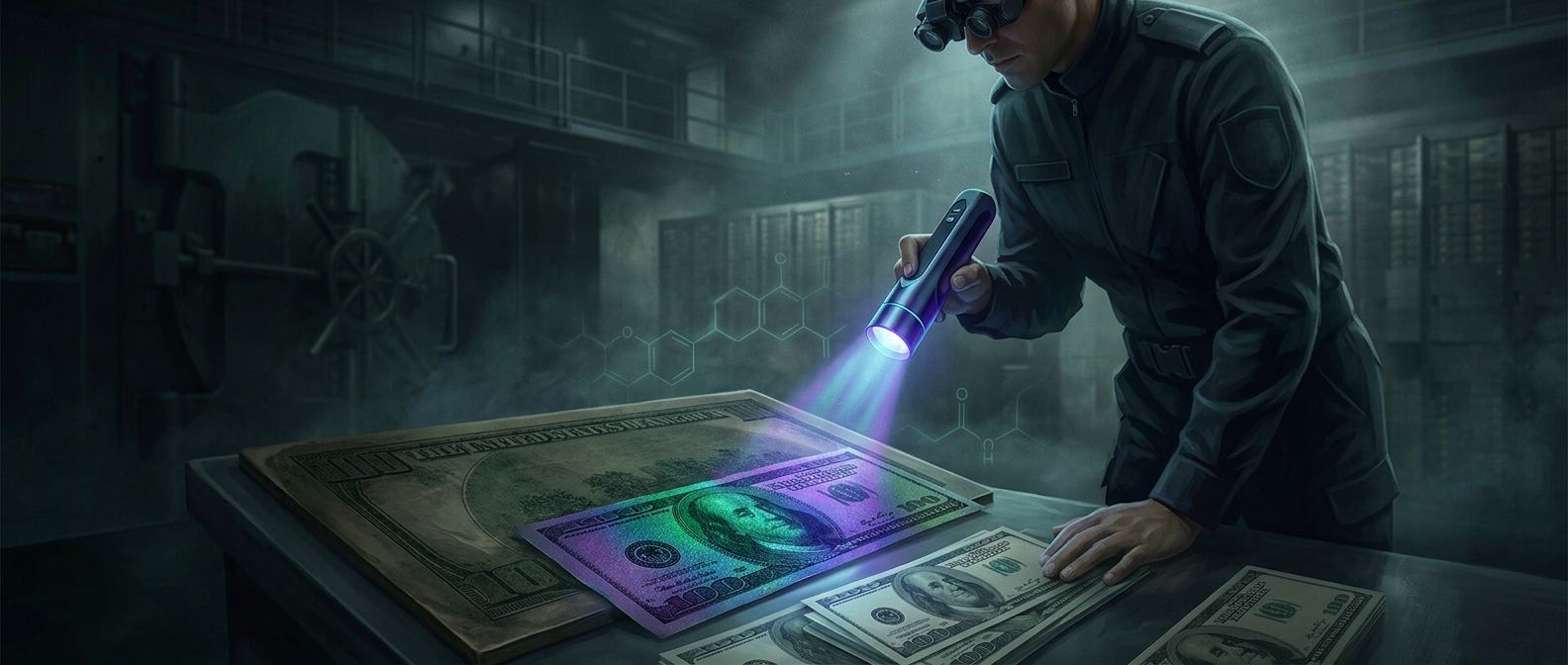
A Color Change Built Into the Surface
The green-to-copper shift is an optical effect, not ink changing chemically. The ink contains microscopic flakes with reflective surfaces. As the note tilts, light reaches those flakes and bounces toward the eye at a different angle; the reflected color changes with that geometry. The flakes’ engineered coatings help determine which colors are reflected, while ordinary colored inks mainly produce their appearance by absorbing some wavelengths of light and reflecting others.
That means the feature is most visible in motion. A note held flat may show mainly one color; tipping it makes the reflective particles send a different color toward the viewer. The change is a designed property of the ink, not a special effect added by a screen or a change in the paper itself.
Why Make Security Visible?
Angle-dependent color is useful because it gives people a quick feature to check without equipment: tilt the note and look for a clear shift. Reproducing that behavior is harder than copying a static patch of color. A counterfeit may imitate one appearance, but matching how the feature changes as the note moves requires specialized materials and printing.
The feature is one layer of banknote security, not a guarantee on its own. Its practical advantage is that a physical action—tilting the bill—reveals something a flat image cannot show: the color depends on the angle between the light, the note, and the observer.