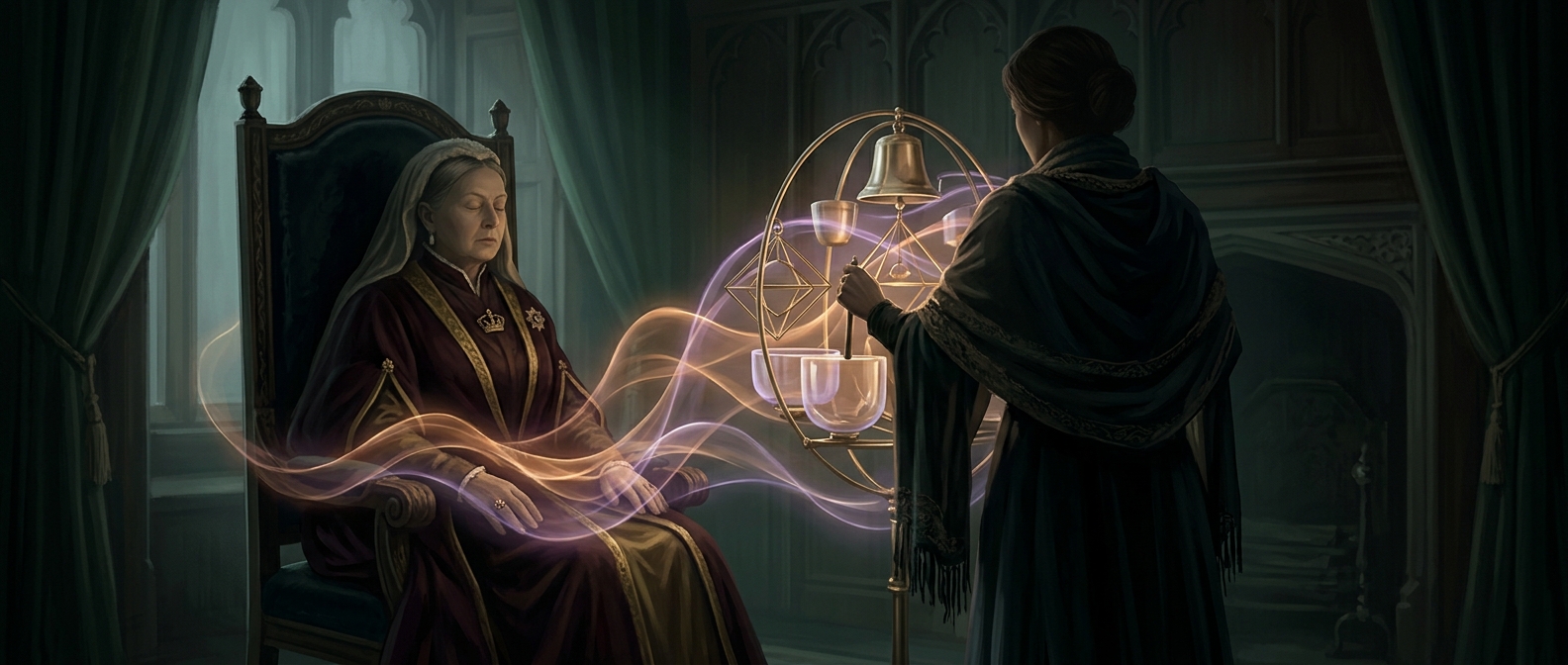
Healing at a distance, by an unseen signal
Lilian Bailey’s appeal rested on a striking idea: a healer might work on someone without touching them—or even having them in the room. A lock of hair or a drop of blood was treated as a stand-in for the person, supposedly carrying enough of a connection for the practitioner to detect or influence illness through it.
Bailey was a trance medium, meaning she claimed to receive information while in a trance. Radionics practitioners used a related language of invisible vibrations: they said illness could be identified or treated by sending the right influence through a biological sample. In this view, the sample was not medicine in the ordinary sense. It was a link through which the healer could act at a distance.
Why the royal connection mattered
King George VI and the Queen Mother were among Bailey’s favored clients, and they also entertained radionics practitioners. Their interest shows that such healers could find a place in elite private life, alongside conventional care—not that the royal family’s attention established the treatments’ effectiveness.
The method’s central claim depended on an invisible connection that could not be checked in the way a dose of medicine or a physical procedure could. That made personal trust and the healer’s reputation especially important. A tiny sample could be presented as carrying the whole person into the treatment, even when the patient was elsewhere.
The detail worth remembering is how little the healer needed to begin: a strand of hair or a drop of blood could be treated as a remote point of contact, turning distance itself into part of the claimed cure.