Why a Sunken Stone Raises the Water
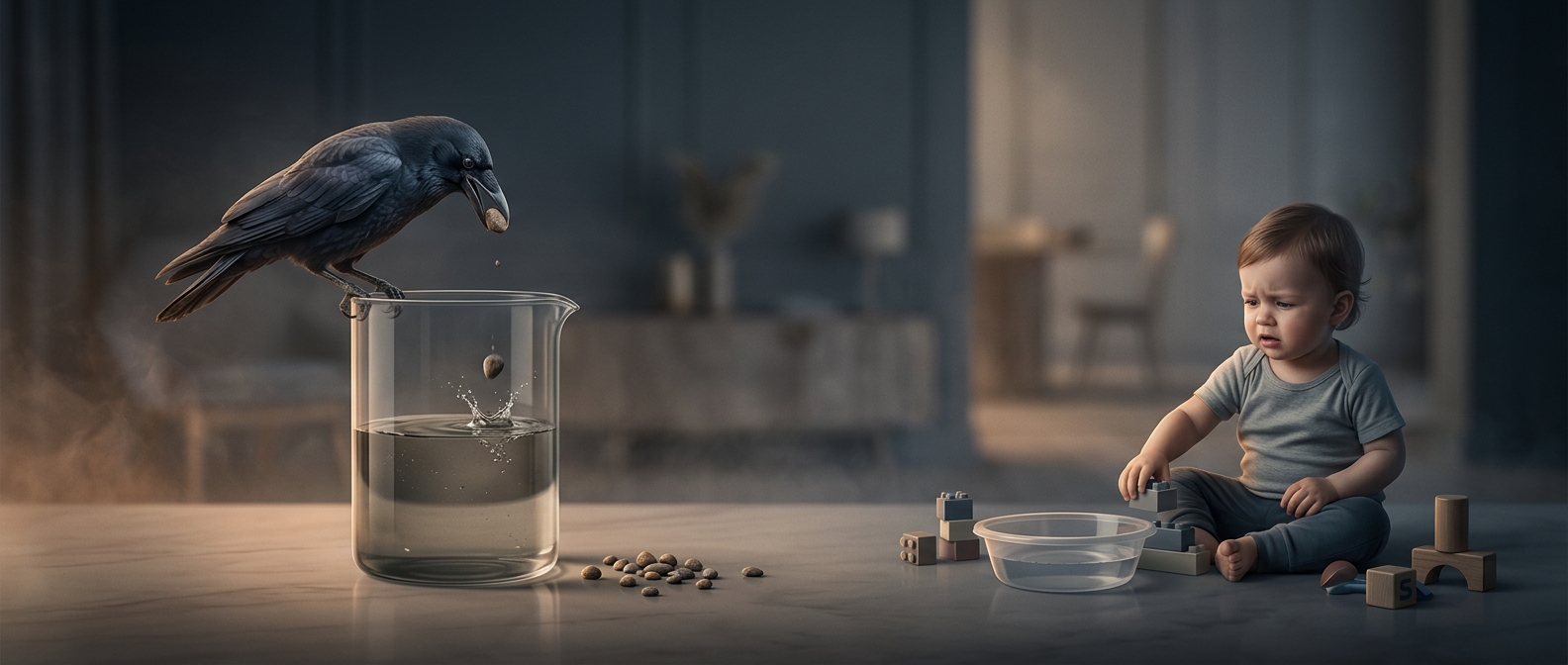
A stone does not add water to a narrow container; it takes up room inside it. Because the water cannot occupy the same space as the stone, the level rises. This is displacement—the same physical effect that lets a boat sit higher in the water when more cargo is loaded aboard.
The useful stone is not necessarily the biggest one. What matters is how much space it occupies below the surface. A floating object can be large, but it displaces only enough water to support its own weight; a light object that barely presses into the water may raise the level very little. A dense stone sinks and displaces water equal to its submerged volume.
The Puzzle Tests More Than Picking Things Up
To reach a treat resting above the water, a crow must connect an action with a delayed result: dropping a suitable object changes the water level, which changes how far the treat is from its beak. The payoff comes only after enough objects have been added, so the bird has to keep choosing useful items rather than simply repeating the first move.
That makes the task a test of practical cause and effect, not just dexterity. A crow that selects sinking objects is acting on a useful distinction between objects that make the water rise and those that do not. The same basic principle is familiar from everyday experience—putting something into a full glass can make water spill—but here it becomes a tool for solving a problem. A small stone can function like a step, bringing a distant reward within reach.