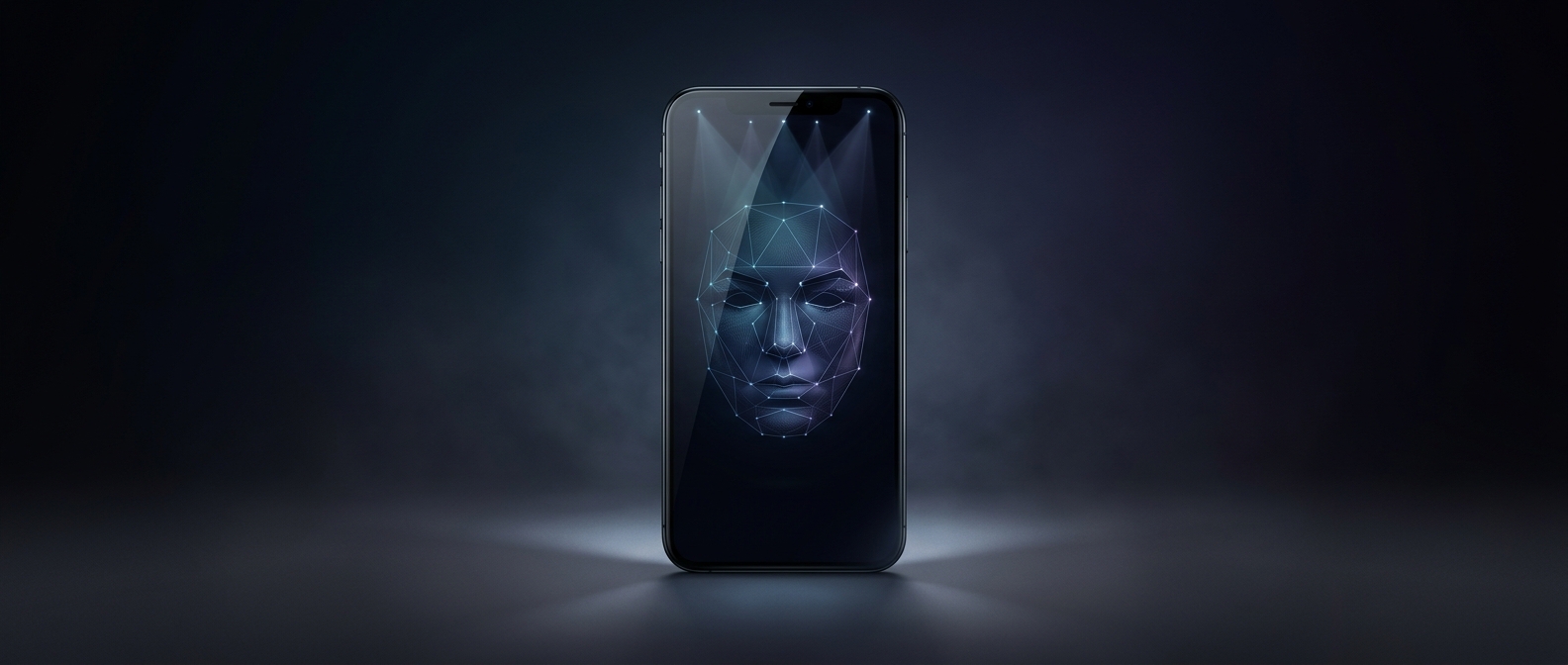
How Face ID turns a face into a match
When you enroll, the iPhone’s TrueDepth system projects and reads a pattern of infrared dots across your face. Software uses that depth information, along with an infrared image, to create a mathematical representation: a compact set of features useful for distinguishing your face from someone else’s. It is not a conventional photograph kept for later viewing.
At an unlock attempt, the phone captures a fresh scan and compares its representation with the enrolled one. The important question is not whether the two scans are pixel-for-pixel identical; expressions, lighting, and small changes in appearance can vary. The system looks for a sufficiently close match in the features it was designed to measure.
Why the storage location matters
The enrolled representation is held in the Secure Enclave, a protected hardware component inside the device. Face matching happens there, rather than sending the scan to an online service for comparison. Ordinary apps can ask the operating system to authenticate you, but they do not receive the stored face representation itself.
That design limits where biometric data can travel, but it does not make the representation meaningless: it remains sensitive information because it is tied to your identity and used to recognize you. The practical distinction is that Face ID keeps a purpose-built matching record on the phone—not a photo library of your face—and uses that record to decide whether to unlock.