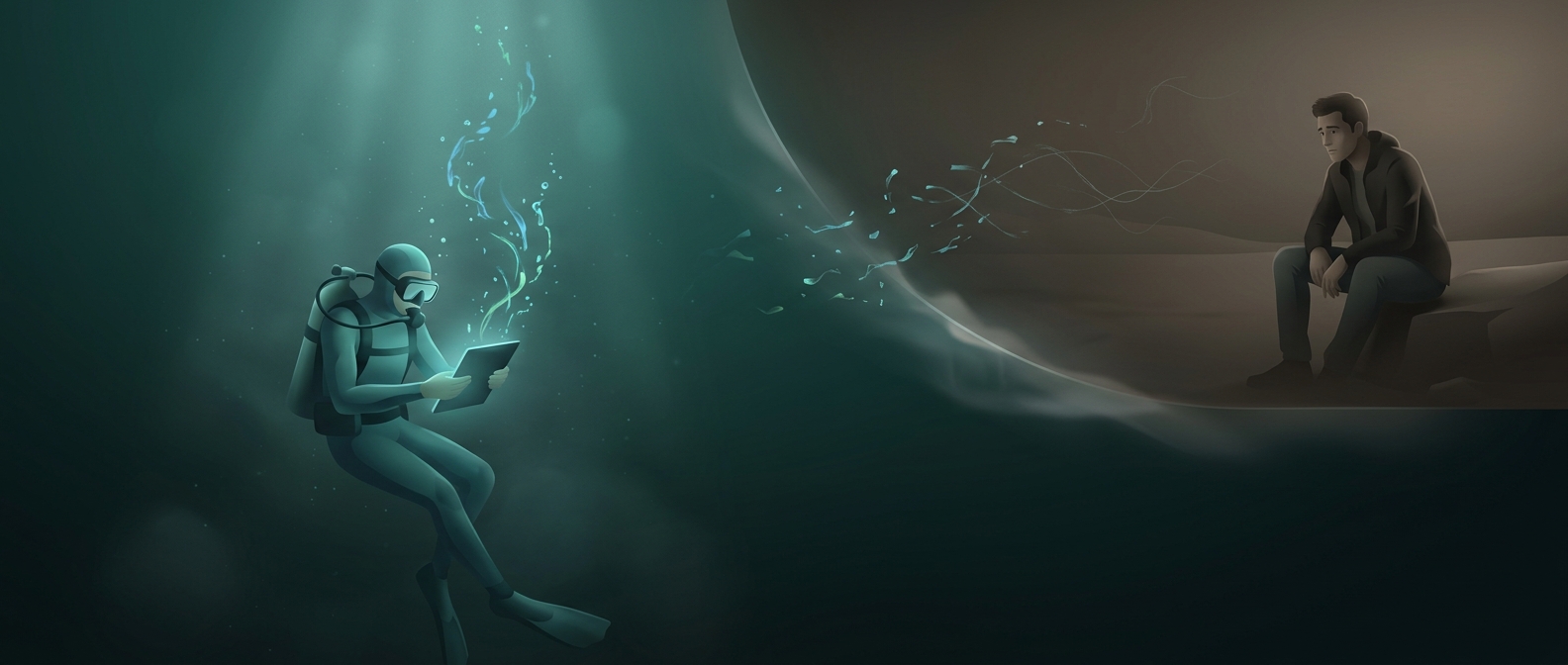
How the learning setting becomes a memory cue
Memory is not a recording that the brain replays in isolation. When people learn something, they also register parts of the surrounding situation—such as where they are and what the environment feels like. Later, details that overlap with that original setting can help bring the memory to mind.
In the diving experiments, the contrast was unusually clear: participants learned words either underwater or on land, then tried to recall them in one of those settings. Recall tended to be better when learning and retrieval took place in the same environment. Underwater conditions were therefore more than a backdrop; they supplied cues associated with the words.
Why matching conditions can help
A cue does not contain the memory itself. Instead, it can make the route to that memory easier to find. Returning to a familiar context may reactivate some of the mental associations formed during learning, giving recall more than one path to follow. If the setting changes, those particular cues may be harder to use, even though the information has not simply vanished.
This is called context-dependent memory: recall can depend partly on the match between the circumstances of learning and remembering. The effect is a tendency, not a guarantee that people will forget everything in a different place. What someone knows, how well they learned it, and other available cues still matter.
The practical lesson is about cues, not water
The result does not mean that studying underwater is a useful memory trick. A dive is a distinctive environment, but ordinary settings can also become associated with what people learn. More generally, it shows why recall can feel easier in the room, routine, or situation where information was first encountered: the surroundings may quietly help point the mind back to it.
That makes the diver’s change of setting more than a scenic detail. It can remove a familiar cue—and returning to the original environment can restore one.