Before the armies looked like armies
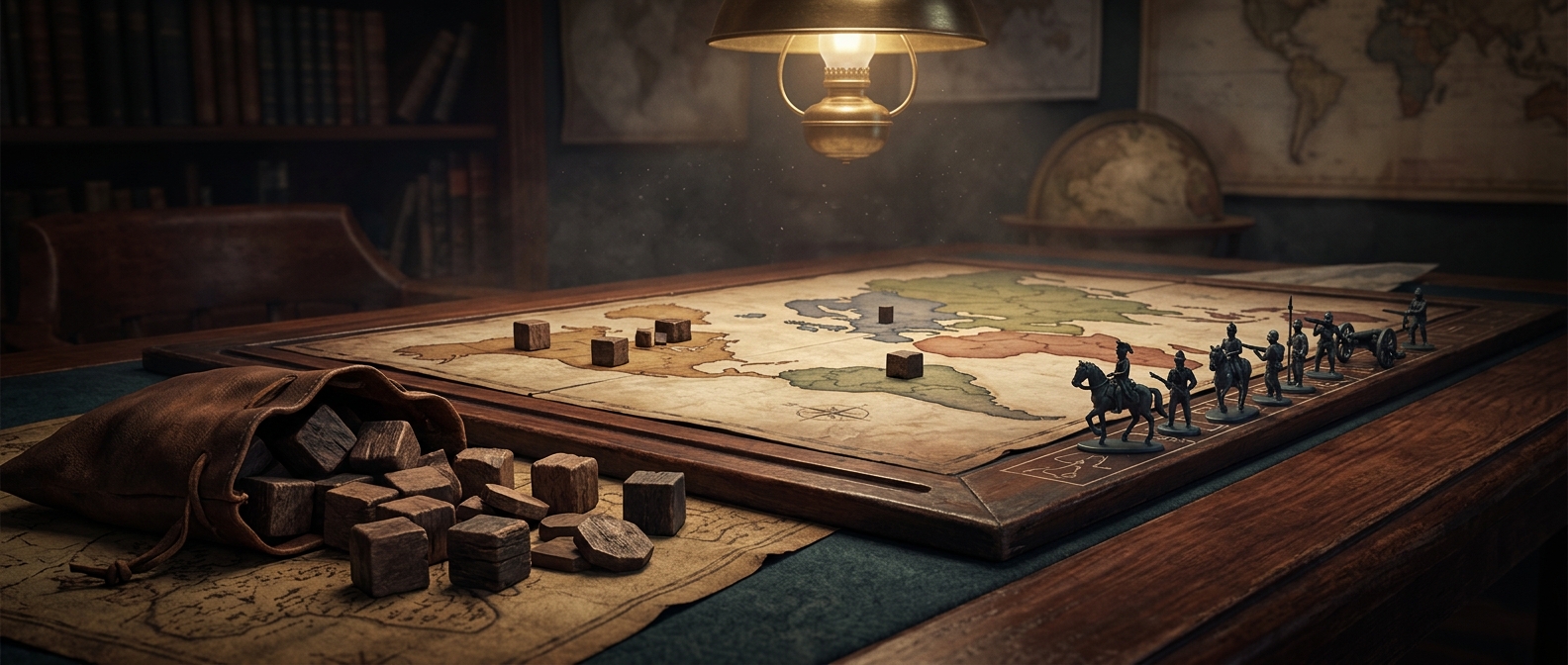
In Risk’s original version, a force was represented by a small wooden block, not a miniature soldier. That made each piece a counter: a marker whose job was to show how much military strength a player had in a territory, rather than to depict a particular person or unit.
On a crowded map, that distinction matters. Players needed to see which territories they controlled and compare the forces gathered there. A simple block could do that work without asking anyone to read details into its shape. The army was, first of all, a number of pieces on the board.
What a change in pieces changes
Soldier-shaped pieces make an army feel more literal. Blocks keep it abstract. That contrast affects the table’s visual language: a stack of cubes reads as accumulated strength, while a miniature invites the eye to imagine troops standing in formation.
The blocks also point to a basic principle of board-game design: components are not just decoration. Their shapes influence how quickly a state of play can be read and what players picture while making decisions. In Risk, the essential question is whether one territory has enough force to challenge another; the wooden cubes made that force visible without representing a battlefield in miniature.
The original blocks are a reminder that the familiar look of a game is only one way to express its rules. Before the armies became recognizable as soldiers, the map’s competing powers were already there—measured out in small, unmistakable pieces.