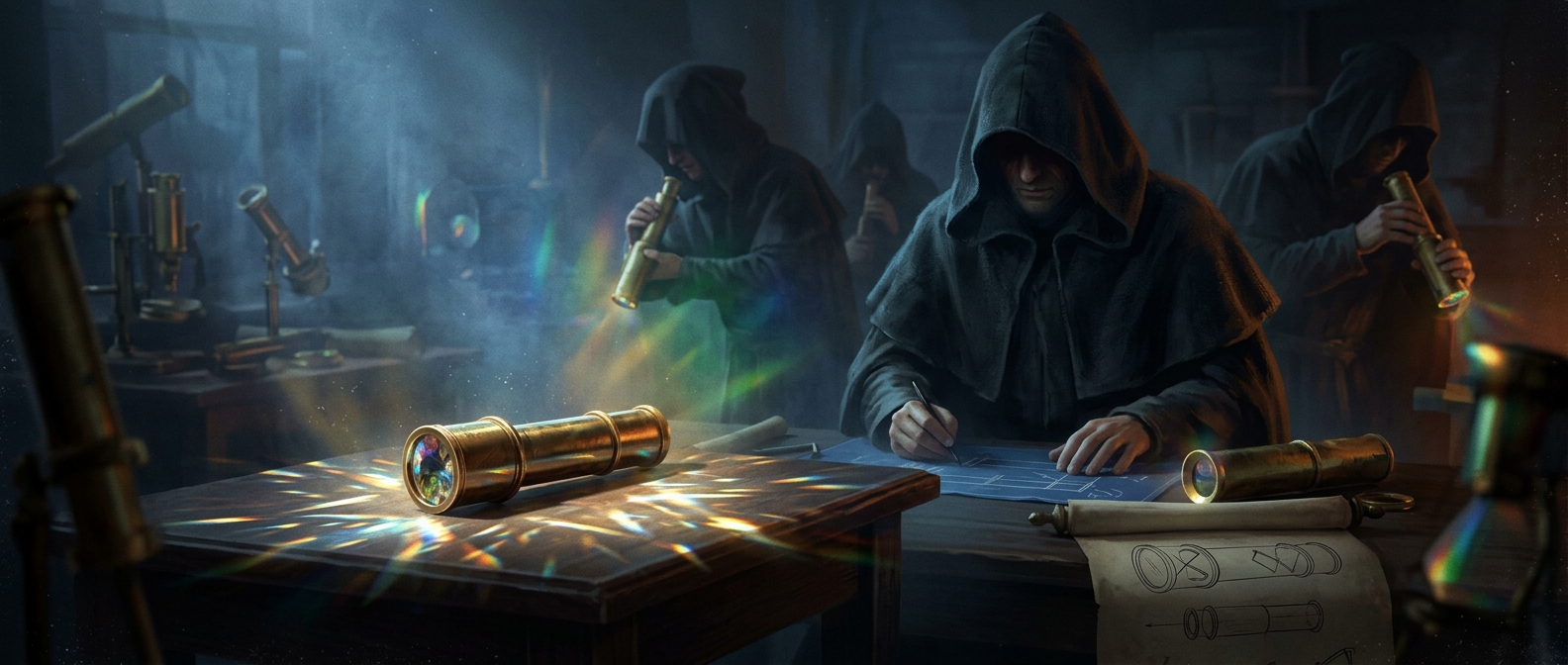
A pattern-making instrument in a tube
David Brewster’s kaleidoscope turned a few small pieces of colored glass into a seemingly elaborate design. Inside the tube, angled mirrors reflected the pieces repeatedly. Each reflection produced another copy, arranging the colors into a symmetrical pattern that changed when the tube was turned.
That mechanism was the invention’s strength—and a vulnerability. It relied on a straightforward arrangement of mirrors rather than a complicated machine. Once people understood how it worked, making a similar device did not require reproducing an intricate mechanism.
Popularity outpaced the patent
Brewster patented the kaleidoscope in 1817, but a patent could not by itself ensure that an invention would remain exclusive in practice. Copies appeared quickly, and the device spread as a popular toy. The same simplicity that made it easy to enjoy also made it comparatively easy to imitate, limiting Brewster’s ability to profit from its success.
The contrast is striking: the view through a kaleidoscope can look endlessly complex, but the principle behind it is simple enough to fit inside a small tube. Its visual abundance helped make it a sensation; that same simplicity made the invention hard for its creator to keep to himself.