How Ibn Battuta kept moving across continents
Ibn Battuta’s journey began in 1325 with a familiar goal: traveling from Morocco to Mecca for the pilgrimage known as the hajj. What turned that trip into an extraordinary itinerary was a chain of opportunities. In each region, he could join established routes, find other travelers, and seek support from rulers and officials who valued educated visitors.
He was trained as a Muslim legal scholar, and that skill gave him a role beyond that of a passing tourist. At different points, he worked as a judge or received patronage—financial or practical support from powerful hosts. Such ties helped him settle temporarily, then continue onward when a new position, invitation, or route opened up.
A journey made of many kinds of travel
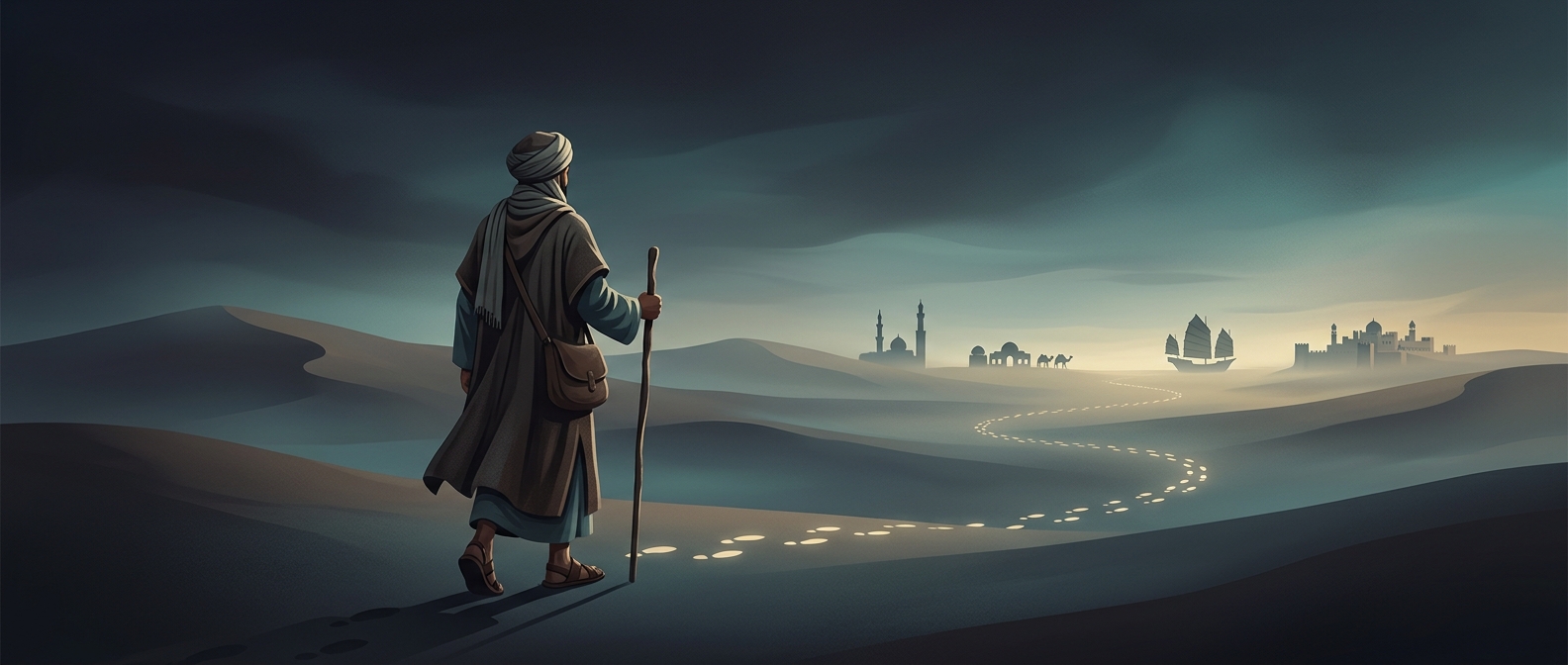
“On foot” captures only part of the undertaking. Long-distance travelers in the 14th century moved by whatever a route allowed: walking, riding horses or camels, and crossing water by ship. Caravans—organized groups traveling together—made desert journeys more manageable, while busy roads and ports linked cities across North Africa, the Middle East, East Africa, South Asia, and beyond.
The route was not a single expedition planned in advance. Ibn Battuta repeatedly traveled to a destination and then chose or was drawn toward another. A job could redirect him; a political upheaval could make a route dangerous; a ship or caravan could determine when and where he could go next. His travels stretched across decades because each leg depended on the people, transport, and circumstances available at the time.
What the mileage can—and cannot—tell us
The often-cited distance of about 75,000 miles is an estimate reconstructed from the places he described visiting, not a measurement recorded along the way. It conveys the scale of his movements, but not a precise path: routes could bend, repeat, or change, and surviving accounts do not function like a modern travel log.
The striking point is how a pilgrimage became a life shaped by connected routes and relationships. Ibn Battuta’s distance was accumulated one journey at a time, as roads, ships, and hosts carried him into the next region.