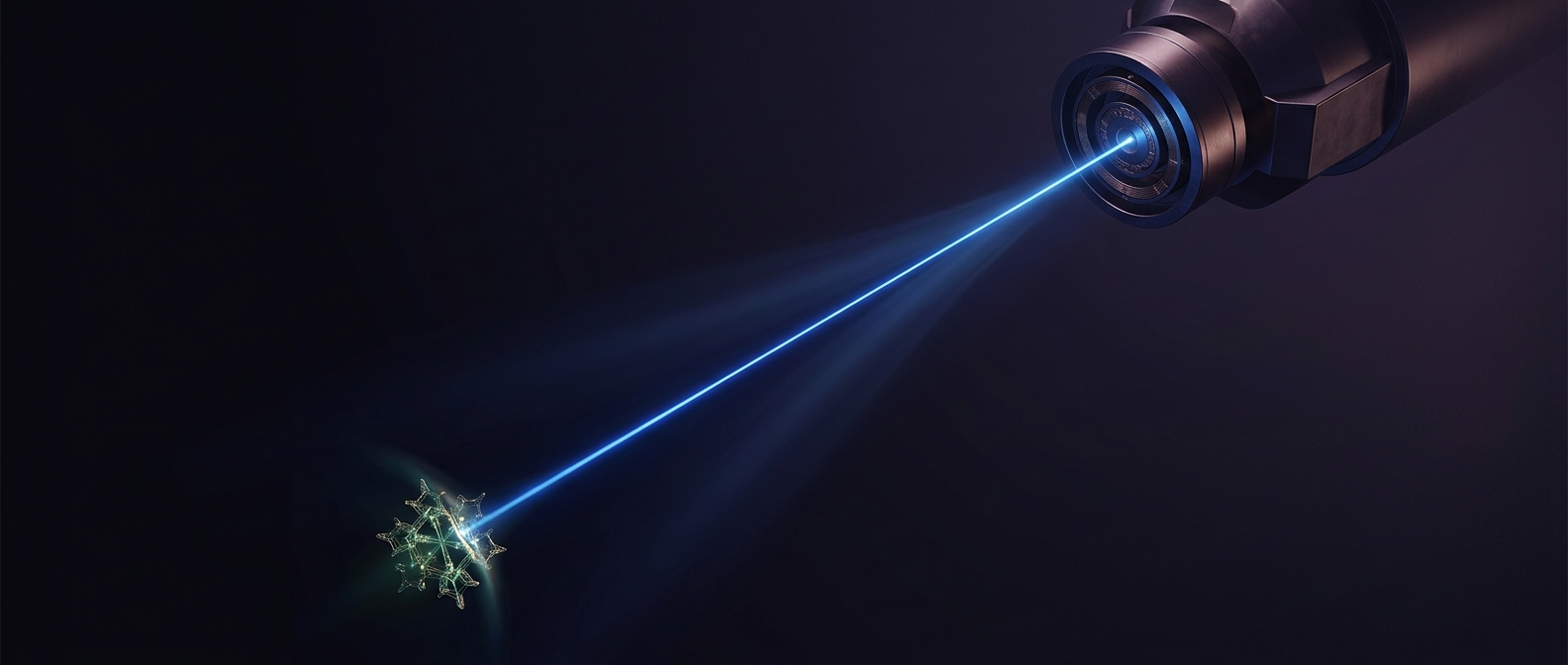
How a calorimeter turns a particle into a measurable shower
A particle detector cannot usually weigh a fast-moving particle directly. Instead, a calorimeter makes the particle surrender its energy inside a block of dense material. The incoming particle collides with atoms or their nuclei, producing secondary particles. Those particles collide again, creating a cascade called a particle shower.
As the shower spreads through the detector, it loses energy to the material. The calorimeter is built to absorb much of that cascade, converting the particle’s original energy into signals that sensors can record.
From deposited energy to a reading
Different calorimeters sense the deposited energy in different ways. In one design, the material heats very slightly, and sensitive devices measure the temperature change. More commonly in particle experiments, the shower produces flashes of light in a scintillating material, or frees electrons in a gas or solid; sensors turn that light or charge into electrical signals.
The detector’s layers and sensors reveal how the shower develops, while the total signal provides an estimate of the energy deposited. Physicists calibrate that signal against known detector responses to translate it into an energy measurement. Dense absorber helps contain the shower in a manageable space; alternating it with sensing layers lets the instrument track where the energy went.
Why “destroying” can still yield a measurement
The original particle is generally absorbed or transformed, so the detector does not preserve it for later inspection. But its energy is not simply lost: it is redistributed among the shower and the detector’s heat, light, or charge. By collecting those traces, a calorimeter measures a particle through what it leaves behind—much as a sealed block can reveal an impact through the heat and signals generated inside it.