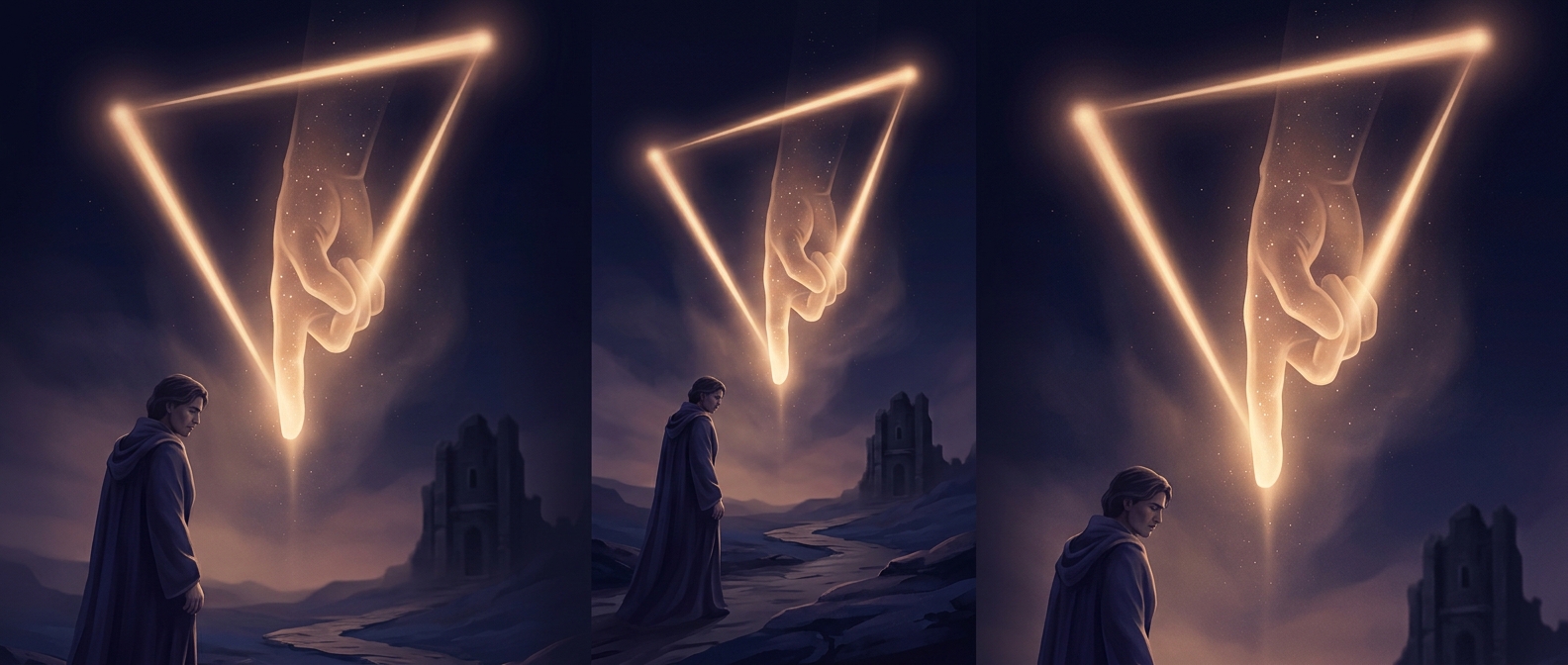
Why astrologers call a Yod a “finger of destiny”
A Yod is identified by the angles between three planets in a birth chart: two form a sextile, an angle of about 60 degrees, while each forms a quincunx, about 150 degrees, to a third planet. The quincunxes make the configuration look like a long, narrow triangle tapering toward that third planet, often called the apex.
The “finger” metaphor comes from that shape—and from the way astrologers interpret its geometry. In this tradition, a sextile suggests an available connection between the two planets at the base, while a quincunx suggests a mismatch that calls for repeated adjustment. The apex planet becomes the point where those adjustments are thought to collect and find expression.
A purpose framed as a recurring challenge
Astrologers who use Yods often read the apex planet’s sign and house for clues about the kind of response or life area involved. For example, they may interpret the pattern as a need to keep adapting how a planetary drive is expressed, rather than as a single event or a fixed prediction. The language of “destiny” describes the pattern’s perceived insistence: it is treated as a theme that may repeatedly demand attention.
That is an interpretive convention within astrology, not a claim that the chart determines someone’s choices. Different astrologers can give the same configuration different emphasis, and they may consider the planets’ signs, houses, and other chart aspects before drawing conclusions. The memorable label therefore points less to a guaranteed fate than to the Yod’s central reading: a life theme understood as taking shape through ongoing adjustment.