From Engine Workshop to BMW
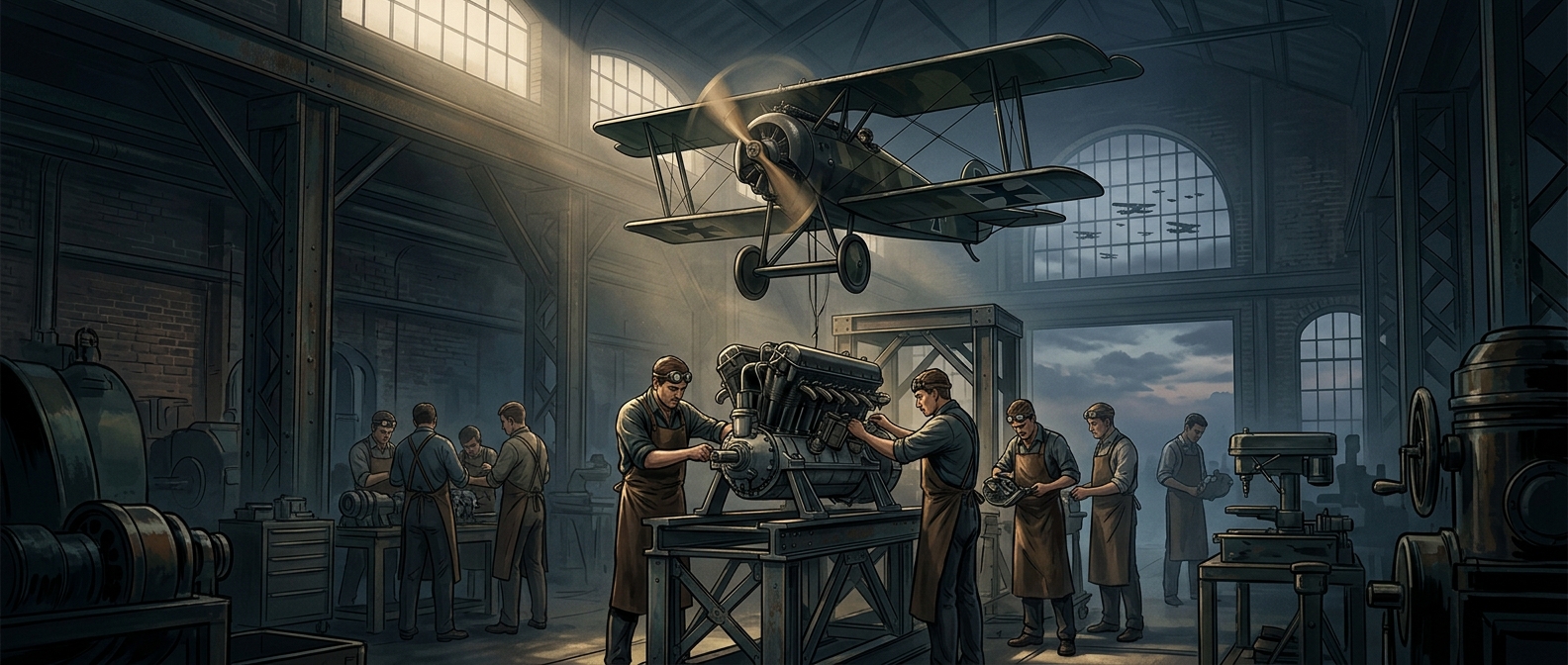
BMW’s early business was not making cars but building aircraft engines. The company took shape in Munich during World War I, when demand for powerful, reliable engines made aviation a fast-growing industry. Its name—Bayerische Motoren Werke, or Bavarian Motor Works—still reflects that industrial beginning.
Aircraft engines were a demanding specialty: they had to deliver power while staying light enough to lift a plane. Developing them gave the young company experience in precision manufacturing, an expertise it would later apply to other kinds of machines.
When the Market Disappeared
After Germany’s defeat in 1918, the postwar settlement sharply restricted the country’s ability to build military aircraft. BMW could no longer rely on its original market. Rather than simply wait for aircraft production to return, it looked for customers elsewhere.
The company moved into products that used related skills and machinery. It made industrial engines and motorcycle components, then launched its own motorcycle in 1923. Motorcycles offered a practical route into vehicle manufacturing without requiring BMW to begin with a full-sized car.
The Badge and the Business Behind It
BMW entered carmaking in 1928 by taking over an established automobile factory in Eisenach. That step turned diversification from a way to survive the collapse of its first market into the foundation of a broader vehicle company.
The blue-and-white badge is often read as a spinning propeller, a fitting image for BMW’s aviation past. Its colors also echo the Bavarian flag, and the propeller association became especially familiar through later advertising. The emblem therefore links the modern carmaker to its origins in two ways: through regional identity and through the engine business that first gave BMW its name.