How forest aerosols become cloud seeds
Pine trees release volatile organic compounds—gases produced by their leaves and needles. In the atmosphere, these gases can react with oxygen and other chemicals, forming tiny particles called aerosols. Some particles are small enough to be carried far from the trees that produced them.
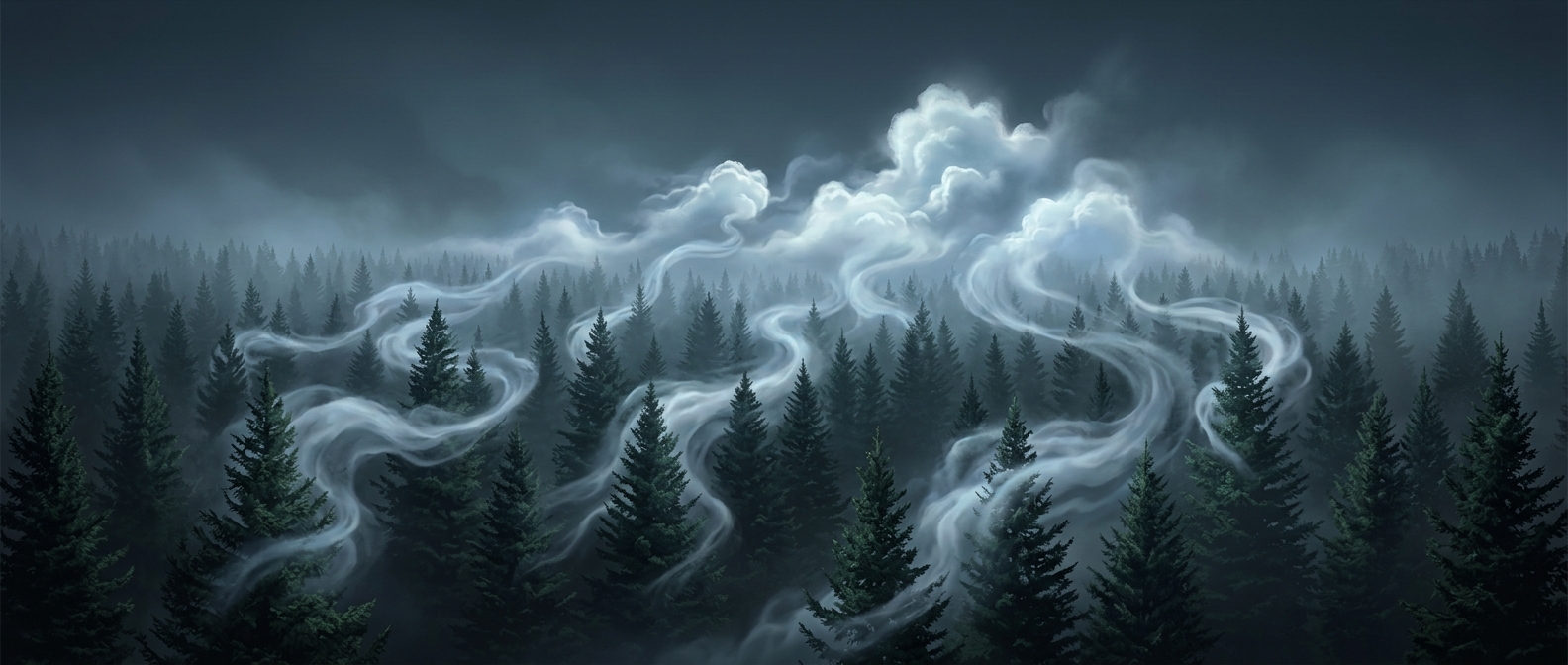
When humid air cools, water vapor does not always turn into droplets on its own. It more readily condenses on a particle that can serve as a cloud condensation nucleus: a microscopic surface where water gathers. As many droplets form and grow, they can make a cloud visible.
Why the trees cannot make clouds by themselves
Aerosols supply potential starting points, not water or the conditions that lift and cool air. A forest’s particles matter only when moisture is abundant and the atmosphere is favorable for condensation. Without those conditions, the particles can remain suspended without producing a cloud.
The effect also depends on the particles’ size and composition. Some attract water more readily than others, and a particle must be large enough—or gather enough water—to help form a droplet. So the forest’s contribution is part of a chain: tree emissions become aerosols, humid air supplies water, and weather determines whether that water condenses.
A living influence on local skies
Because vegetation can add cloud-forming particles to the air, forests are not merely beneath the weather; they can contribute to the ingredients from which clouds develop. That does not mean every pine stand reliably creates its own clouds. It means that, when the air and weather cooperate, particles released by the trees can help turn invisible water vapor into visible droplets overhead.