When Mario Moves Faster Than the Numbers Can Track
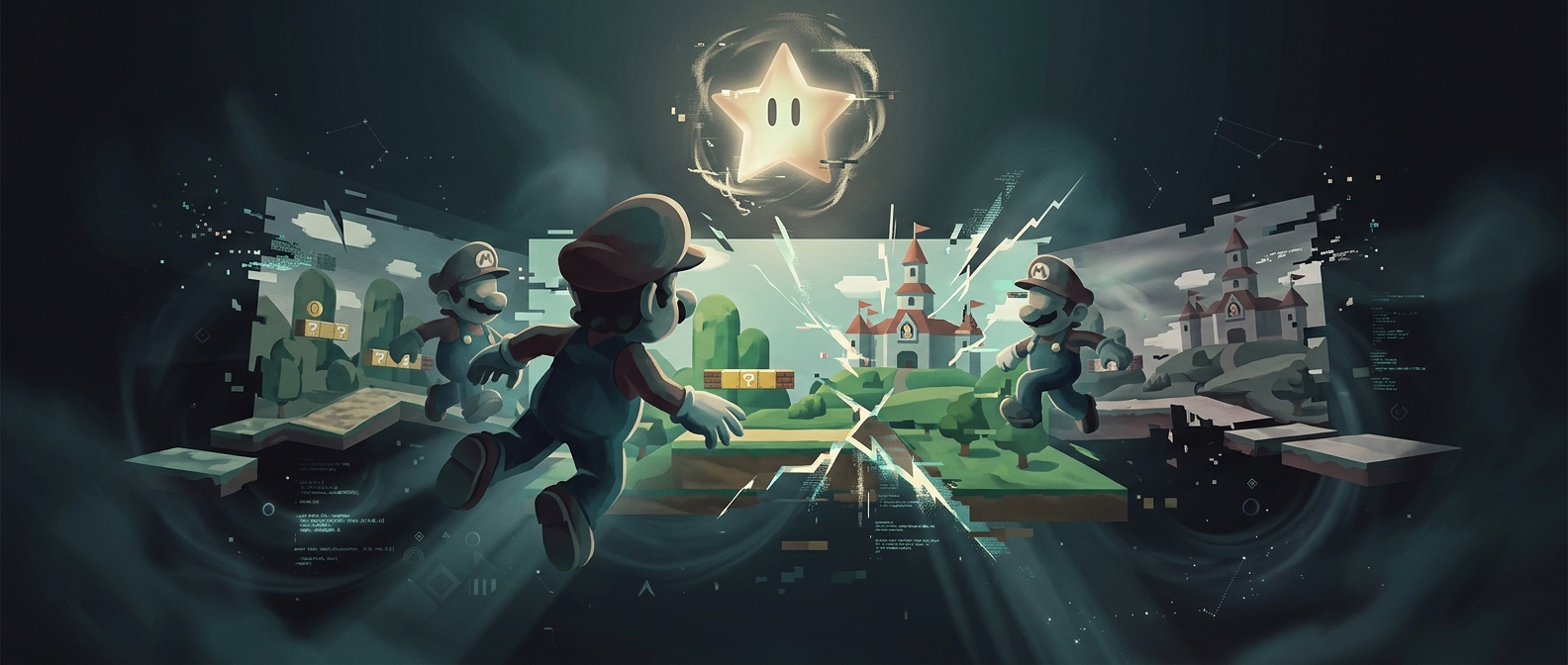
Super Mario 64’s world is managed through coordinates: numbers that tell the game where Mario and everything around him are. The game repeatedly updates those numbers as Mario moves, then uses them to decide what he touches and how the environment responds.
Those coordinates are stored with floating-point numbers, a way of representing very large and very small values efficiently. But a computer has only a finite number of digits to work with. As a value grows, the gaps between the numbers it can represent grow too. At extreme speeds, a movement step can become large enough that the game cannot represent every intermediate position precisely.
How a Rounding Error Becomes a Glitch
Ordinarily, those tiny numerical limits stay invisible. At unusually high speed, however, the game’s calculations can lose the fine distinctions needed to keep Mario’s position and the surrounding physics in sync. Different calculations may effectively place him in different coordinate grids—overlapping ways of interpreting where he is—rather than agreeing on one clean location.
That mismatch is what gives the glitch its “parallel universe” character. Mario has not entered another literal world; the game is producing incompatible versions of his position through its own arithmetic. The same systems that normally keep movement and collisions consistent can then behave in unexpected ways.
The striking part is that the glitch does not require a secret alternate level. It emerges when Mario’s speed pushes the game’s ordinary position calculations beyond the precision they can reliably maintain.