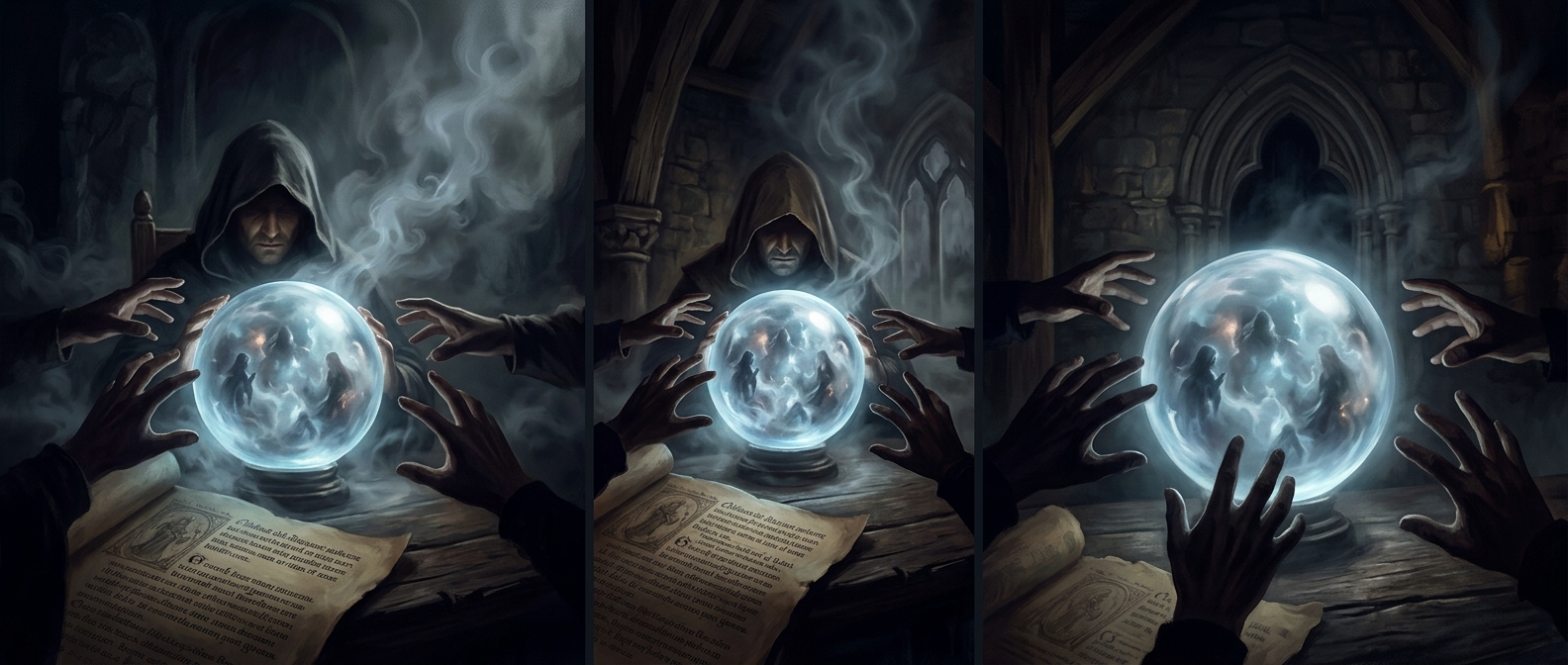
Why a Clear Sphere Can Seem to Hold an Image
A glass sphere offers few stable details for the eye to focus on. Light bends as it passes through the curved surface, while reflections from the room may drift across it. In a dim, quiet setting, prolonged staring can make faint shapes and shifting highlights feel unusually significant. The mind naturally tries to organize uncertain visual patterns into familiar forms—a face, a landscape, or a symbol.
This process is sometimes called scrying: seeking insight by gazing at a reflective or otherwise visually ambiguous surface. A sphere’s smooth, rounded shape gives the gaze a single point of attention, while its distortions leave room for interpretation. The resulting impression can feel less like a thought one has deliberately produced and more like something discovered in the glass.
From Impression to Meaning
The sphere does not supply a fixed vocabulary that every viewer reads the same way. A practitioner may connect an image to a question, a personal concern, or a spiritual framework. That interpretive step is central: the same blur or reflection can suggest different things to different people, and its meaning often depends on the viewer’s expectations and experience.
For believers, scrying can serve as a way to seek guidance or make sense of uncertainty. The experience can be meaningful without establishing that a message came from beyond. What makes the practice compelling is the meeting of a simple optical effect and a deeply human habit: turning ambiguous impressions into a story that matters.