Why Barium Makes a Flame Green
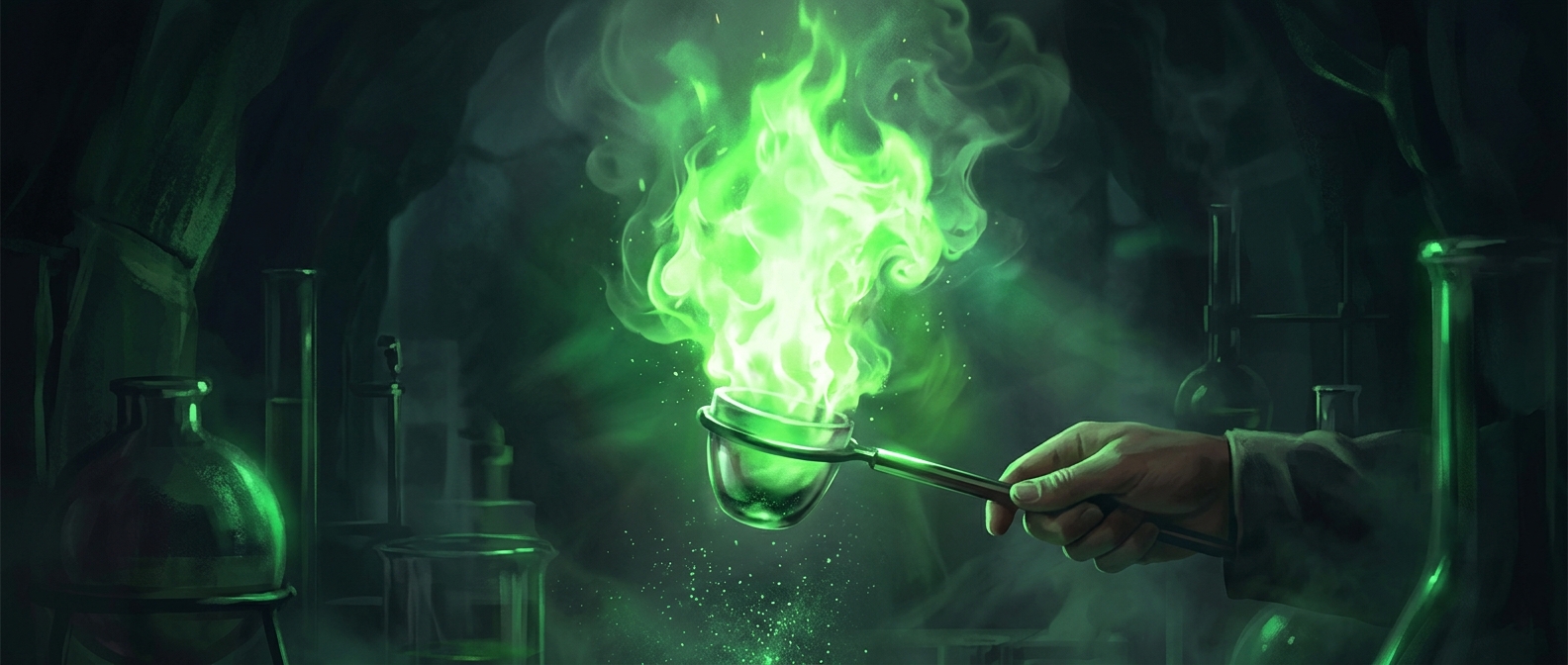
A flame supplies energy to barium atoms, raising some of their electrons to higher-energy states. Those states are temporary. As the electrons drop back down, the atoms release the extra energy as light. The energy of that light determines its color, and barium’s characteristic emissions include wavelengths that appear green to human eyes.
Color Is an Atomic Signature
Heating something does not simply make its light shift toward green. A very hot object can glow red, then yellowish or white as it gets hotter, because its broad glow changes with temperature. Barium compounds work differently: their atoms emit particular wavelengths as electrons change energy levels. Those wavelengths give the flame its distinctive green hue, even though heat is what starts the process.
The atoms are supplied by a barium compound, not by a piece of pure barium burning in the flame. In a fireworks mixture, heat breaks apart and vaporizes ingredients, making barium-containing particles available to emit light. The recipe must also burn hot enough and release the right substances for that color to show clearly.
From Flame Test to Firework
The same atomic behavior can be seen in a flame test, where a small amount of a substance is heated and its emitted color helps identify the element. In fireworks, the principle becomes a design tool: combine a color-producing compound with materials that sustain the display, and the particles’ emissions tint the flame.
That is why changing the ingredients can change a firework’s color without needing to change the flame’s temperature alone. The green is a clue to the atoms present—and a reminder that a flame’s color can reveal what is inside it.