Why the route keeps turning
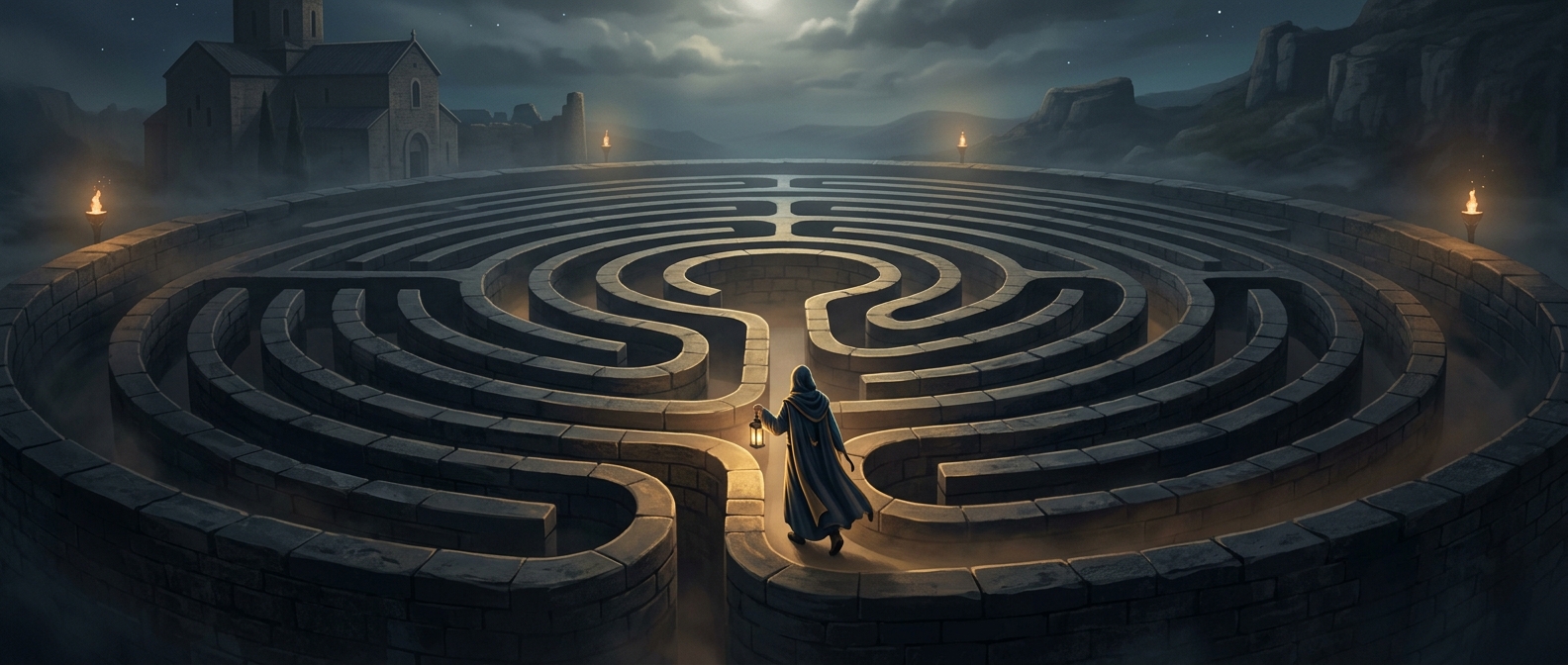
A walking labyrinth is designed to create movement without requiring navigation. Its path may curve back toward the edge after seeming to approach the center, or pass close to a section already walked. Those turns stretch a short distance into a longer journey and repeatedly shift the walker’s sense of direction. Unlike a maze, the design offers no route choices to solve.
Some patterns look as if paths cross. In a properly laid-out labyrinth, however, the lines pass near one another without creating a junction: the walker stays on the same route. Reaching the center is a change in location, not the end of the walk; the way out follows the route back through the pattern.
What the walk is for
The repeated turns can give attention a simple focus: follow the path, notice each change of direction, and continue at a chosen pace. That makes a labyrinth usable for prayer, quiet reflection, or a meditative walk, depending on the person and tradition. The pattern itself does not dictate what someone should think or guarantee a particular emotional effect.
Because there are no choices to make, the experience differs from solving a puzzle. Walkers can concentrate on the rhythm of moving inward and then outward, while the design supplies the structure. A labyrinth’s meaning comes partly from that physical sequence: the center is reached only by continuing through the turns, and leaving requires walking the path again.