Turning molecules into measurable ions
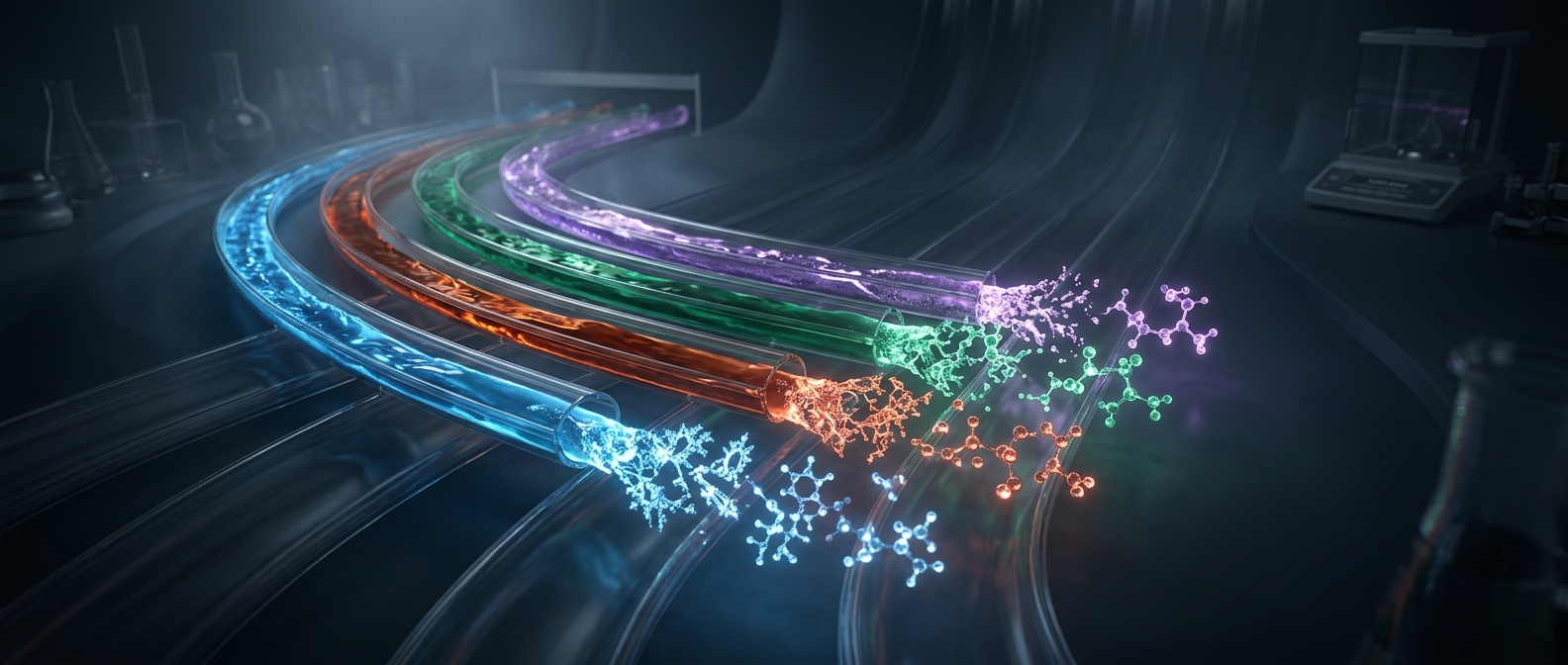
A mass spectrometer does not place a sample on a tiny scale. It first converts some of the sample’s molecules or atoms into ions—particles with an electrical charge. An electric field can then steer those particles, while a detector records when they arrive.
The instrument sorts ions by their mass-to-charge ratio, usually written m/z. A particle’s mass matters, but so does its charge: two ions with the same mass can travel differently if one carries more charge. The instrument’s analyzer separates them according to that ratio, producing a pattern of signal intensities called a mass spectrum.
Reading the pattern
Each signal marks ions with a particular m/z. Researchers compare the pattern with the expected masses of possible components. Some instruments also break molecules into smaller pieces before measuring them. The resulting fragments act like clues: a molecule that splits in a characteristic way can be distinguished from another with a similar overall mass. Isotope patterns—small differences caused by heavier forms of the same element—provide further clues to which atoms are present.
The method can therefore reveal both what kinds of substances are in a mixture and, in suitable setups, how much of each is present. Sample preparation and ionization matter: some substances ionize readily, while others are harder to measure, and the process can alter fragile molecules.
From trace to identity
The key is that a molecule leaves more than one useful mark. Its mass, charge, and sometimes its fragments combine into a recognizable pattern. That lets mass spectrometry detect components that are mixed together or present in very small amounts—turning an otherwise invisible chemical mixture into a set of measurable clues.