Why Pelagia chose the cell
In the traditional story, Pelagia’s retreat was the final turn in a dramatic change of life. After leaving her career as an entertainer, she went to Jerusalem and lived as a solitary ascetic—a person who deliberately gives up ordinary comforts and social life to devote herself to prayer. The Mount of Olives, just east of the old city, offered a setting for that withdrawal while remaining close to the region’s Christian holy places.
The story says she lived under the name Pelagius, presenting herself as a man. That detail belongs to the religious tradition about her: it explains how she could remain secluded without others recognizing her past. The account’s emphasis is less on the practical details of daily life than on the completeness of her renunciation.
What a windowless cell meant
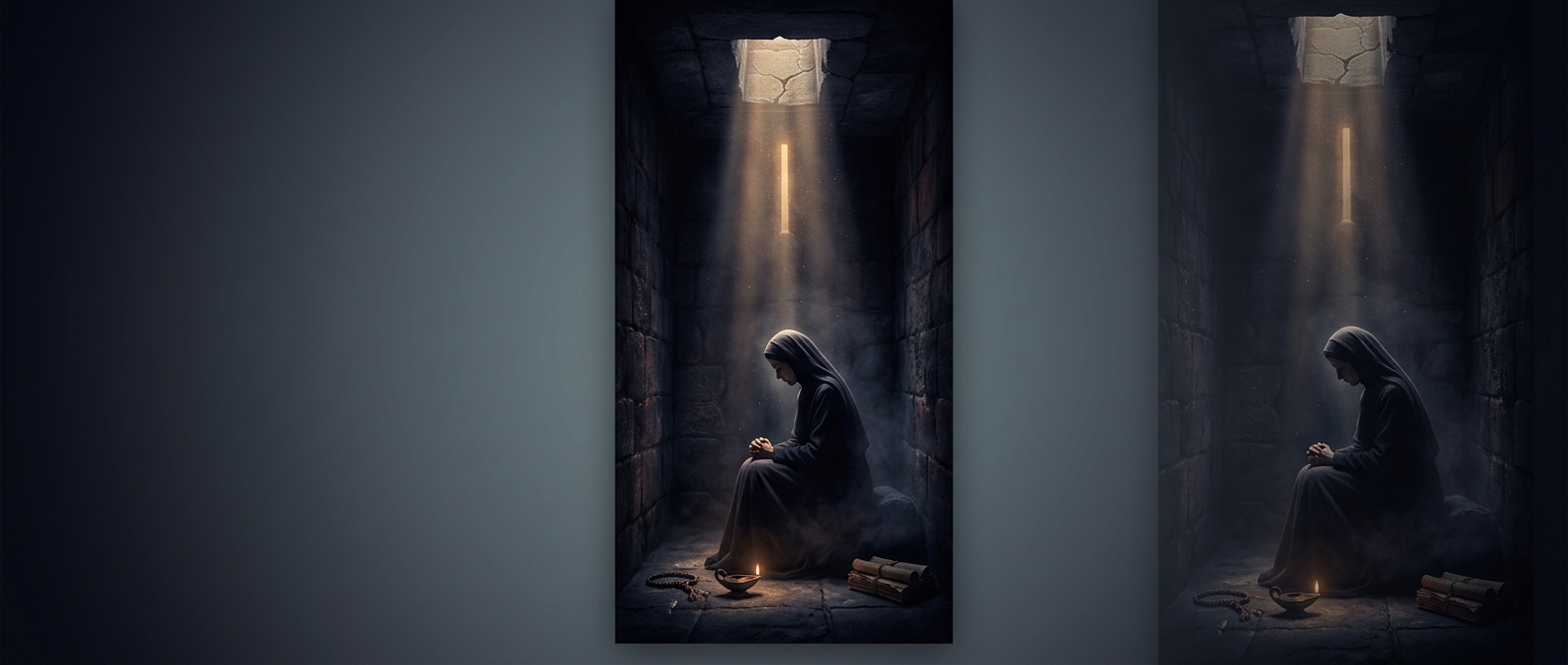
A stone cell was not simply a small home. In the language of Christian asceticism, choosing severe confinement made devotion visible through daily discipline: fewer distractions, fewer possessions, and little contact with the outside world. No window meant that even the ordinary rhythms of weather and passing activity were kept at a distance. It also made the cell a powerful image in the story—an outward sign of a life turned inward toward prayer.
The account does not give enough reliable detail to reconstruct the room’s dimensions or Pelagia’s routine. Its lasting force lies in the contrast it draws: a public performer becomes a hidden, solitary figure. The cell represents not a punishment imposed on her, but a retreat she chose.