Reading a Stroke in the Rock
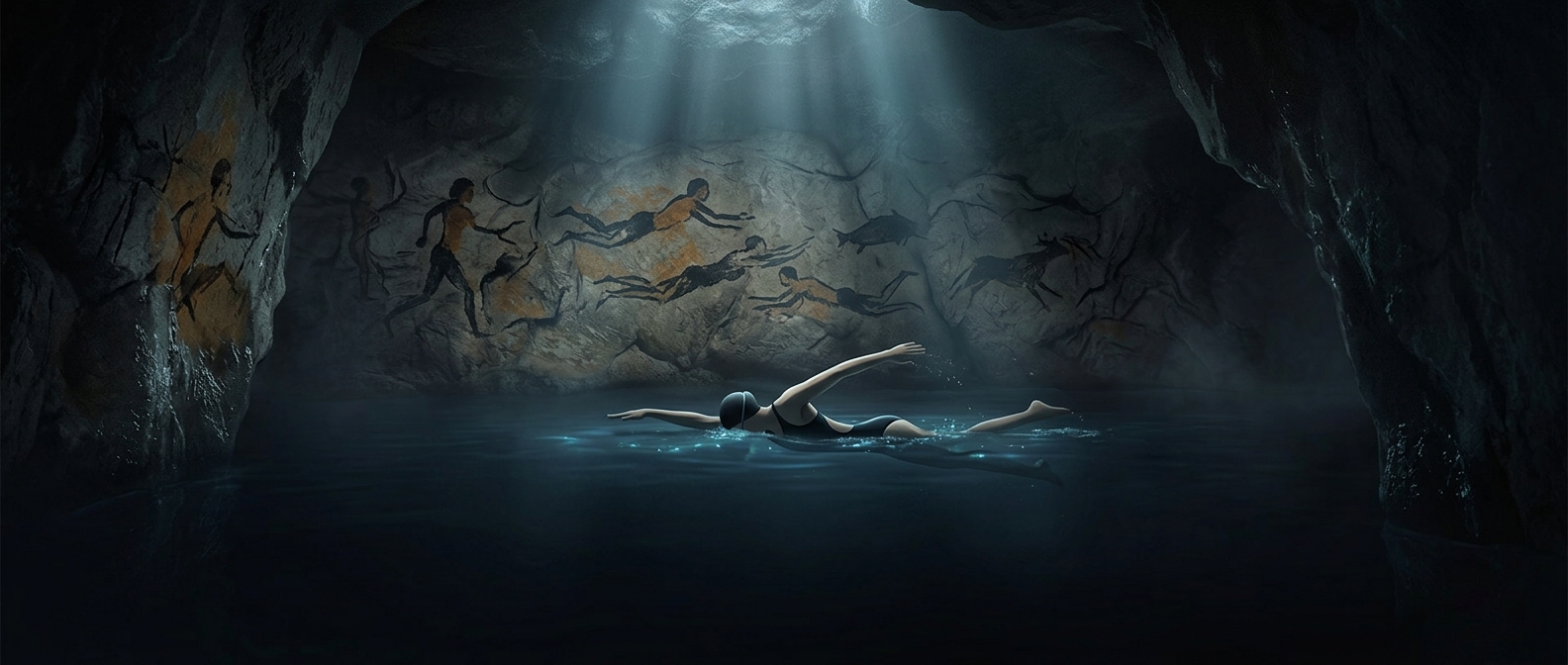
In the paintings at Wadi Sura, in Egypt’s western desert, some human figures are shown with their bodies stretched out and their limbs bent or spread. Researchers have interpreted the poses as swimmers; the outward-and-inward arm movement has been compared with breaststroke. Rock art cannot record motion frame by frame, so the identification is an interpretation—but one that makes sense in the landscape the artists knew.
Breaststroke works through a repeating cycle: the arms sweep out and pull water back toward the chest, while the legs bend and then push outward. The swimmer briefly glides between strokes. A still image can suggest that pattern through the position of the limbs, even though it cannot prove exactly how the movement was performed.
A Sahara With More Water
The paintings belong to a time when the Sahara was not uniformly dry. During the African Humid Period, shifts in rainfall brought more water into parts of North Africa. Seasonal lakes, wetlands, and flowing channels supported people and animals in places that are now stark desert. In that setting, swimming was a plausible part of life, not an impossible scene imagined in a barren landscape.
As rainfall declined over millennia, many water sources vanished or became intermittent. The rock shelter endured while the surrounding environment changed. The paintings preserve a glimpse of a landscape that no longer exists: figures seemingly moving through water, with today’s desert giving no easy sense of how ordinary that scene may once have been.