How the Weeping Angels Made Stillness Frightening
The Weeping Angels’ central trick depends on a simple rule: they can move only when nobody is looking at them. That turns an ordinary cut in a scene into a threat. A figure that seemed safely frozen may be closer the next time the camera returns—or the characters look back.
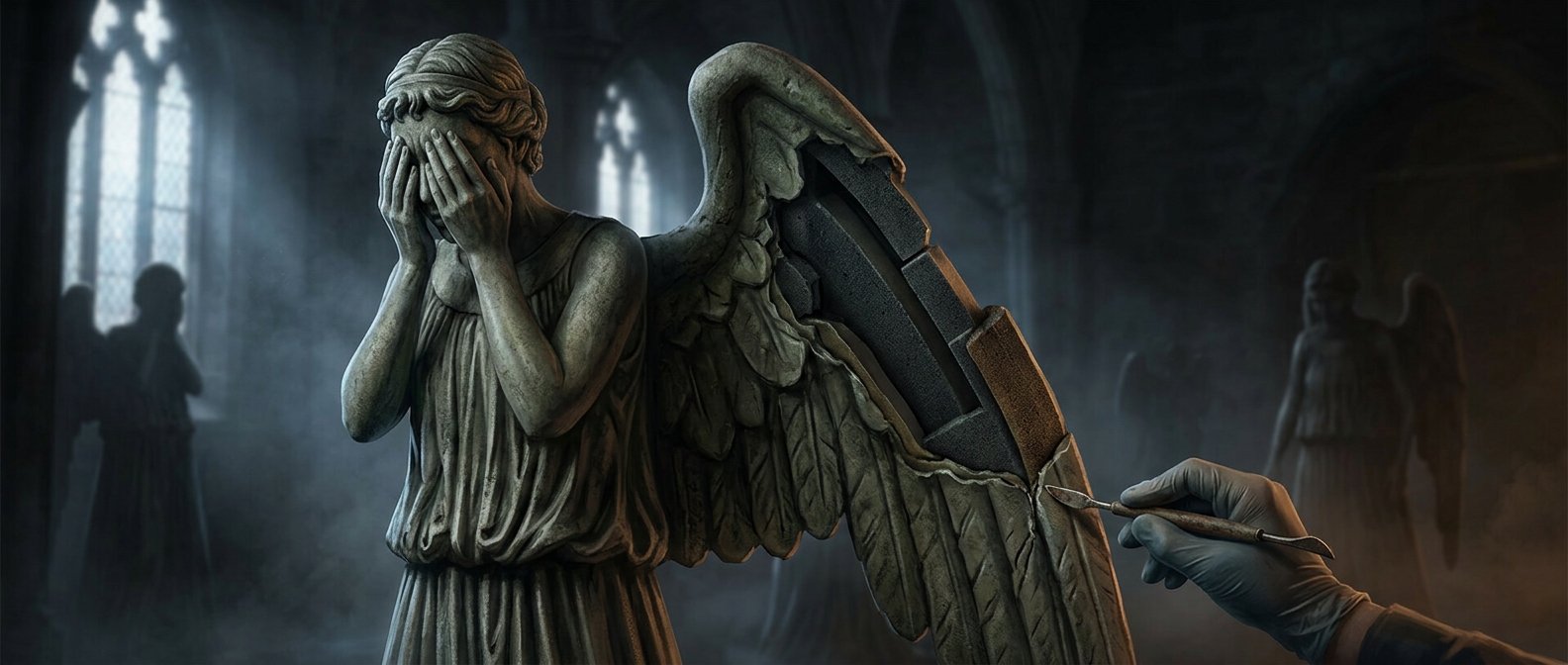
For “Blink,” the Angels were built as costumes for performers, with foam shaped and painted to resemble carved stone. That practical choice let a real body occupy the same space as the actors facing the statues. The effect did not need to show an animated figure crossing the room; it needed the Angel to appear utterly motionless, then be somewhere else.
The Actor Became Part of the Effect
The costume supplied the stone surface, but the performer supplied the stillness. Holding a pose made the Angel read as sculpture, while even a small shift could give away the human underneath. The contrast is what makes the image unsettling: viewers know there is a person inside, yet the figure must look less alive than a statue.
Because the creature’s movement is hidden whenever it is observed, the audience fills in the gap between shots. The practical costume made that gap feel tangible: the Angel was not merely an image inserted into the scene, but a physical presence that could be framed beside the characters. Its most frightening movement is the one the story never lets anyone see.