How a Plowed Field Became a Television Principle
The crucial idea was to treat a picture not as one object to send, but as a sequence of measurements. A camera could inspect a scene in narrow horizontal strips, recording how light and dark changed across each strip. Send those changes in order, then repeat the sequence quickly enough, and a receiver could rebuild the picture.
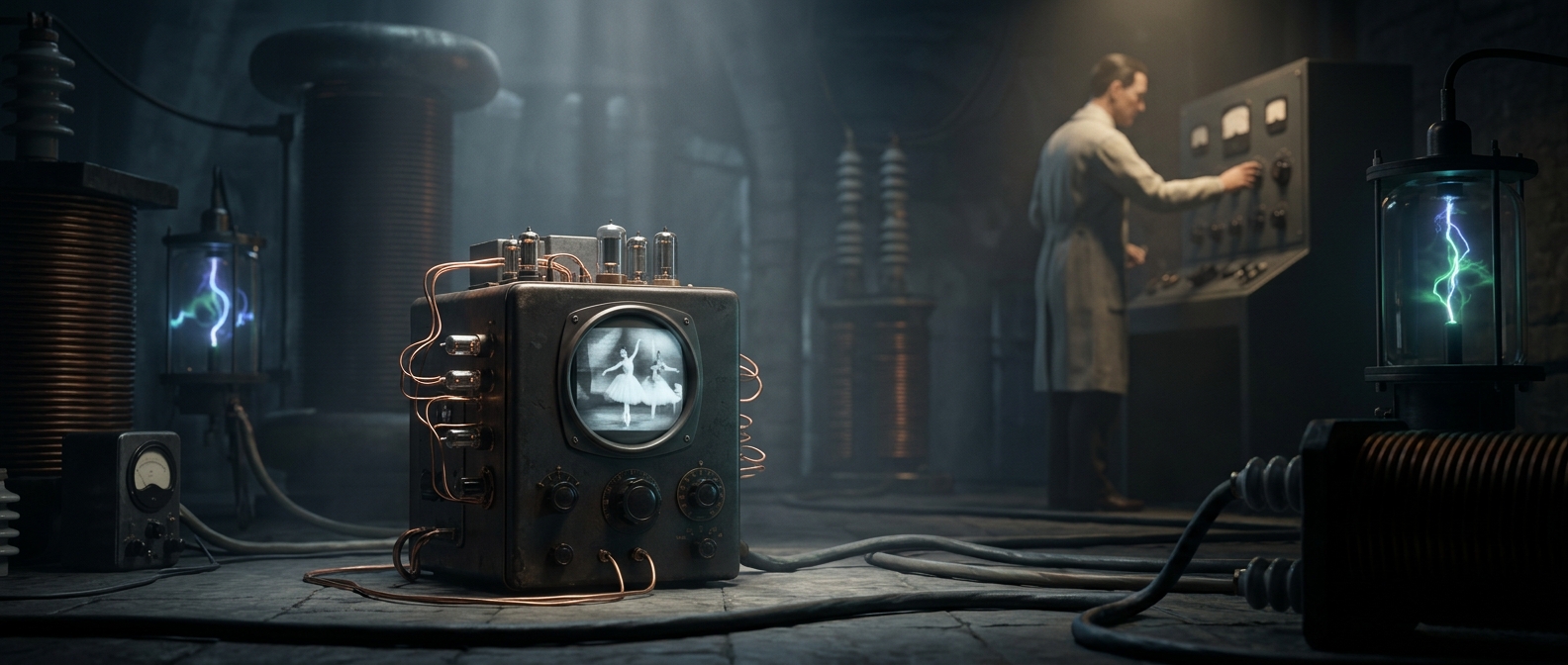
That process is called scanning. In an electronic system, a beam of electrons can sweep across a screen one line at a time. Its intensity varies with the incoming signal, making each point brighter or darker. The beam then starts the next line, and the cycle repeats so rapidly that viewers perceive a complete moving image rather than a spot tracing rows.
Why the Electronic Approach Mattered
Earlier television experiments often relied on rotating disks with holes to break an image into lines and reassemble it. Such mechanical systems faced a basic limit: moving parts had to scan the picture fast enough to look continuous, while still producing enough detail. Farnsworth’s concept pointed toward a different solution—use electron beams and electrical signals to do the scanning, without a spinning image-making disk.
Making that idea work required more than sending a picture. The camera had to turn light from each part of a scene into a changing electrical signal; the receiver had to keep its scan in step and reproduce those changes at corresponding positions. If the timing slipped, the image would distort. If the signal failed to preserve brightness differences, the picture would lose detail.
Farnsworth’s achievement was to turn an intuitive observation into a workable engineering plan. The lasting significance of the field was not that furrows resembled television lines, but that a repeated, orderly sweep could convert a whole image into a stream of information—and let electronics rebuild it elsewhere.