The Light at the End of the Climb
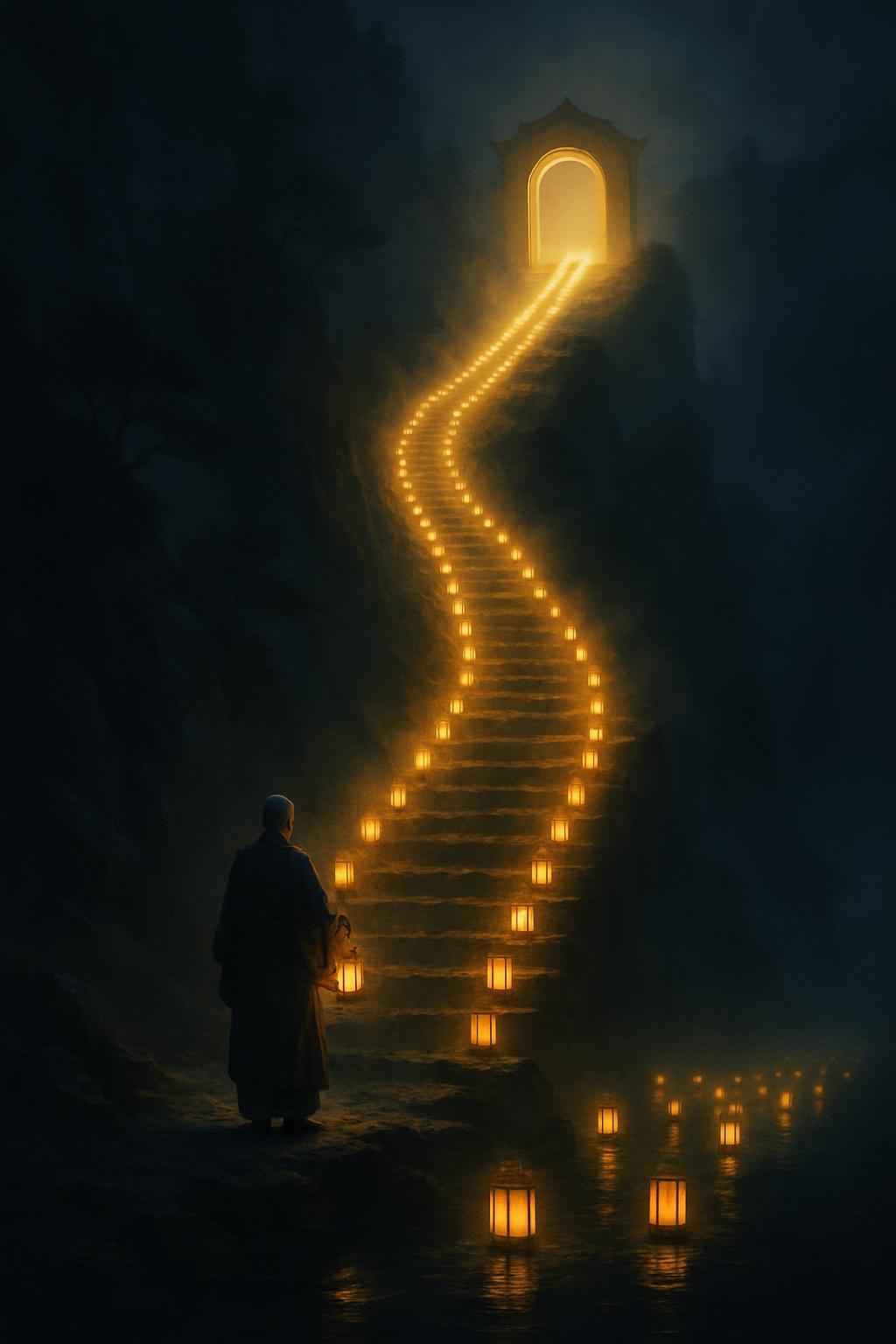
In the Shikoku mountain legend, the monk’s nightly climb turns a steep staircase into a ritual: one lantern, carried upward again and again, marks time through effort. The thousand nights matter less as a calendar than as a measure of persistence. Each trip repeats the same difficult route, until the final night breaks the pattern.
When Separate Lamps Become a Bridge
The reported flare transforms the staircase’s familiar points of light into something larger: a bridge. In folklore, such a passage can suggest a crossing between the ordinary world and an unknown one. Here, the image makes the monk’s departure visible without explaining where he went—or whether the event was miraculous, symbolic, or simply told that way.
That uncertainty is part of the legend’s force. The story gives listeners a striking ending, but no account of what lies beyond it. The monk’s disappearance leaves the light as the only trace of his passage.
Why the Repetition Matters
A sudden blaze would be a spectacle on its own; the thousand-night ascent gives it a history. The final light gathers all those solitary climbs into one moment, making the bridge feel earned within the story. The legend’s lasting image is not just a monk vanishing, but a familiar path changing, for one night, into a way out.