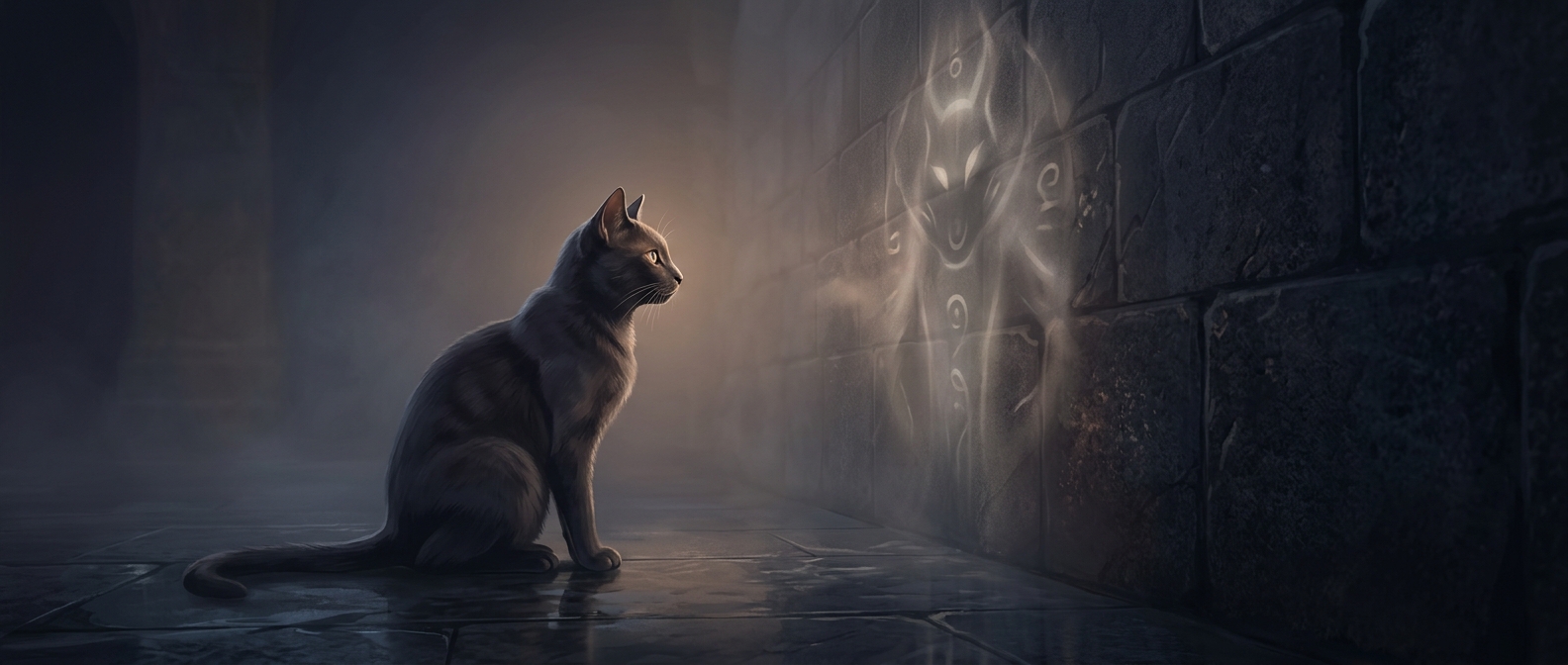
Why a Dog’s Warning Can Feel Uncanny
A dog may bark at a patch of wall or stare into a dark hallway while everyone else sees nothing. The folklore of unseen visitors gives that ordinary mismatch a dramatic explanation: the dog is reacting to a presence beyond human sight. In many households, a watchful animal becomes a kind of witness at the boundary between the familiar home and the unknown.
A Different Set of Clues
Dogs do not need to detect anything supernatural to react to something people miss. They can hear faint sounds, notice scents, and pick up small movements or changes in their surroundings. A noise behind a wall, an animal outside, or a shifting shadow may be enough to make a dog alert, even when a person cannot identify the cause.
That gap in perception leaves room for interpretation. The dog’s posture and bark are visible; the trigger may not be. When the cause stays hidden, a story about an unseen visitor can make the moment feel legible and give the animal’s warning a meaning.
From Watchdog to Omen
Dogs have long occupied a practical role as protectors of homes and people. Folklore can extend that role: the animal is not only noticing danger but warning of something humans cannot perceive. The bark at an empty corner becomes memorable precisely because it turns an ambiguous moment into a scene with a watcher, a threat, and a warning.
The same behavior can therefore be both a real response to a dog’s surroundings and a meaningful sign within a tradition. What makes the story endure is the gap between the dog’s certainty and the human observer’s uncertainty.