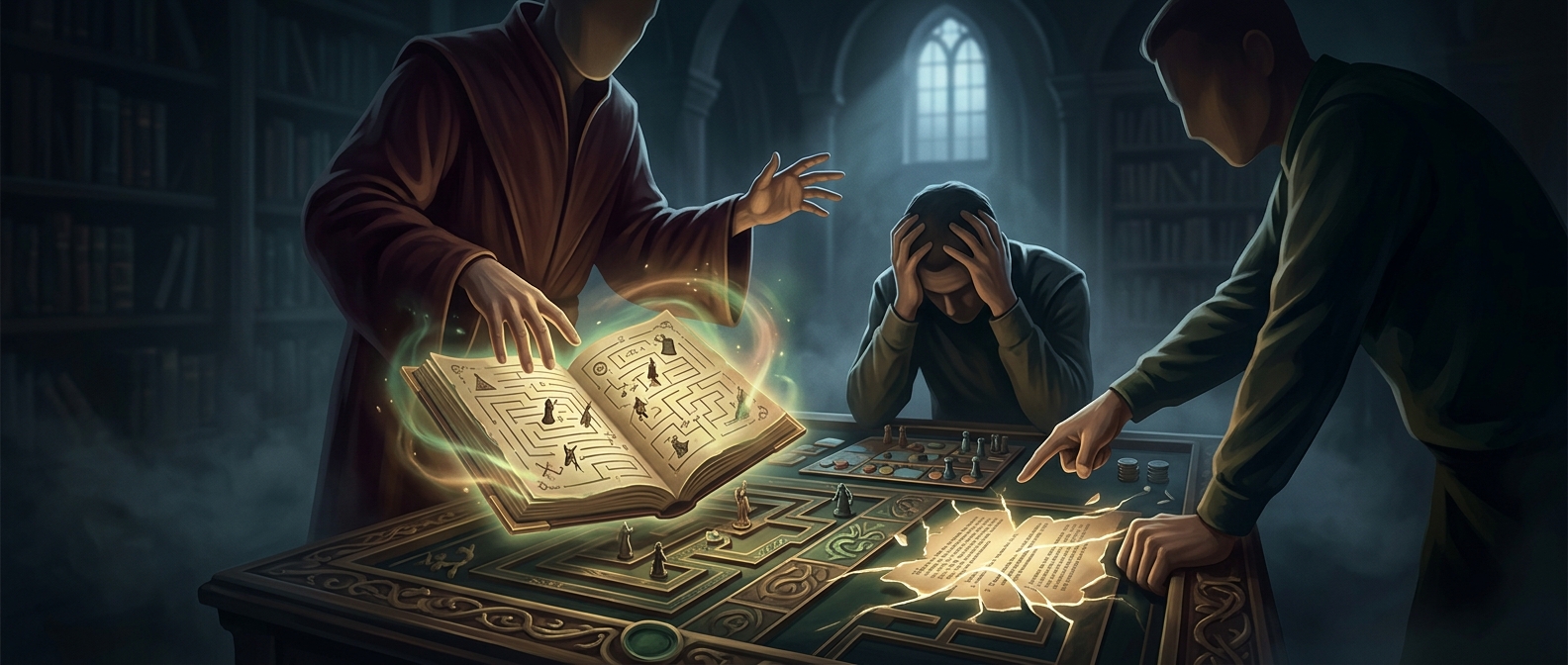
Why Some Board Games Feel Like Contracts
In a rules-heavy game, the difficulty is rarely one especially strange rule. It is the number of rules that interact. A card may change how a unit moves; a movement rule may depend on the space it enters; and a special ability may override both. Players have to remember not just what each rule says, but which rule takes priority when they collide.
That creates a gap between learning the rules and being able to play smoothly. During a turn, players must keep track of available actions, costs, exceptions, and timing. A rule that seemed clear during explanation can become hard to retrieve when a specific situation arises.
Complexity Is a Design Tradeoff
Designers use detailed rules to make choices consequential. Restrictions can distinguish one strategy from another, while exceptions can give a faction, card, or location its own character. But each added distinction asks players to hold more information in mind—and makes teaching the game harder.
Good presentation can ease the burden without removing the complexity. Clear examples, player aids, and reference sheets let players check a rule at the moment it matters rather than memorize every detail up front. A well-structured game can also introduce its systems in stages, so players learn the core turn before tackling less common cases.
The practical test is not whether players can recite the rulebook. It is whether they can find the rule they need without stopping every turn to reconstruct how the whole game works.