How Rangoli Patterns Grow from a Few Marks
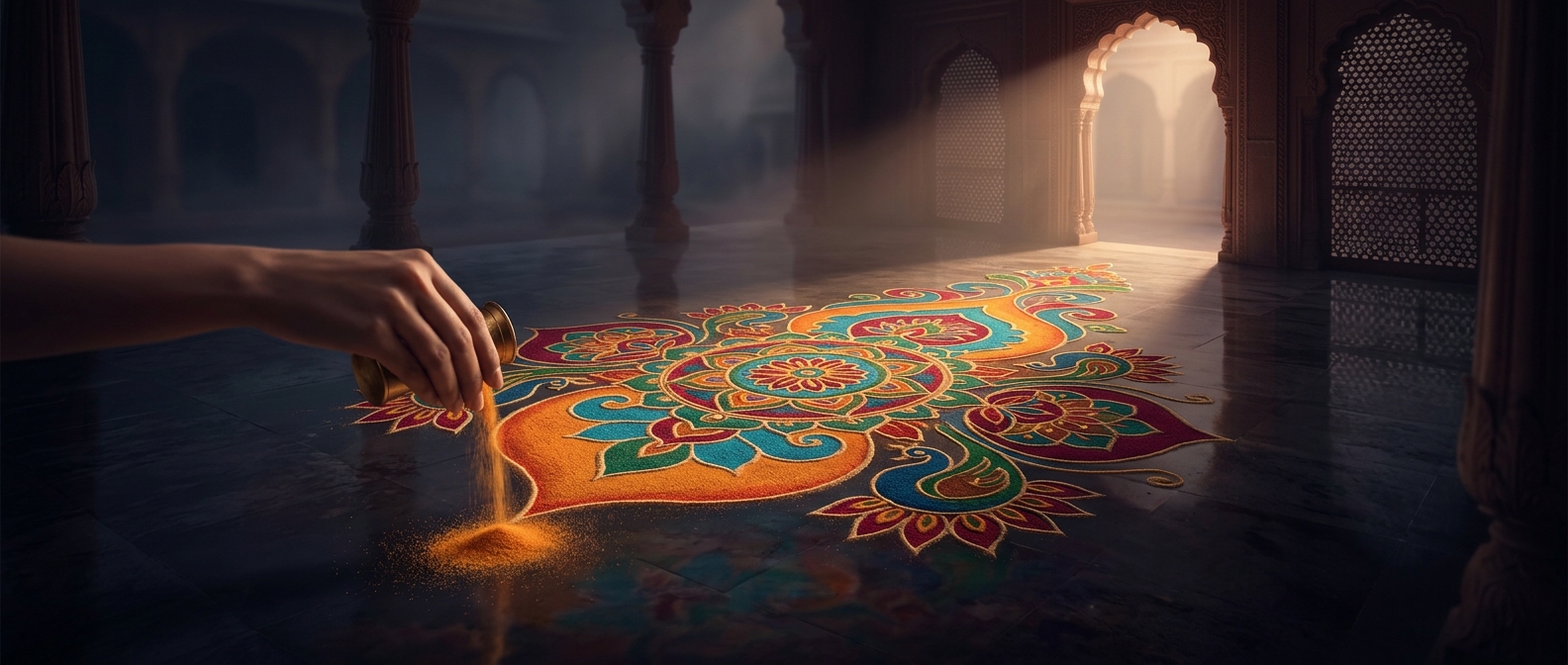
A rangoli often begins not with a detailed drawing but with a simple framework. An artist may place a grid of dots on the floor, then connect or loop around them to build a pattern. Repeated shapes and balanced spacing let a design become intricate while keeping its overall order easy to see. Other rangoli styles are drawn freehand, so the method depends on the design and local practice.
To place a line of powder, the artist lets it sift through pinched fingers, controlling the flow with small movements of the hand. Colored powders can then fill larger shapes or accent the outlines. Rice flour is another traditional material; its pale color makes a strong contrast against a dark floor.
A Welcome Made for a Particular Day
Rangoli is more than floor decoration. In many households, people make it near an entrance as a way to welcome guests and mark a festival or other auspicious occasion. A design can be newly made for the day rather than treated as a permanent picture, tying its beauty to the act of preparing the home.
That timing shapes the work. The artist has to choose a pattern that can be completed before the household needs the space, and a careful walk around it may be part of preserving it. Its temporary nature is part of the art: the design is made to be seen now, not kept untouched forever. When footsteps or a breeze break the lines, the floor records the ordinary life happening around the decoration—and the next occasion can bring a new pattern.