The strong force behaves unlike a stretched rubber band
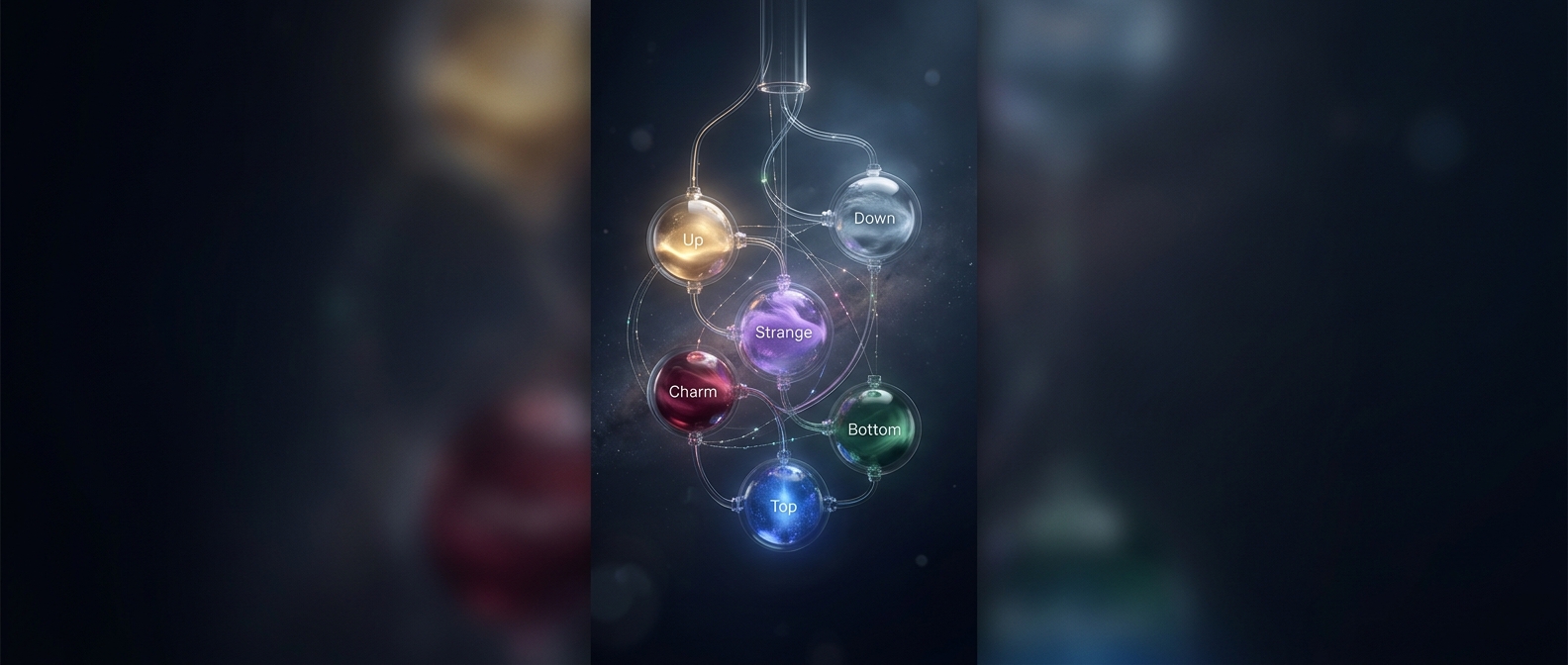
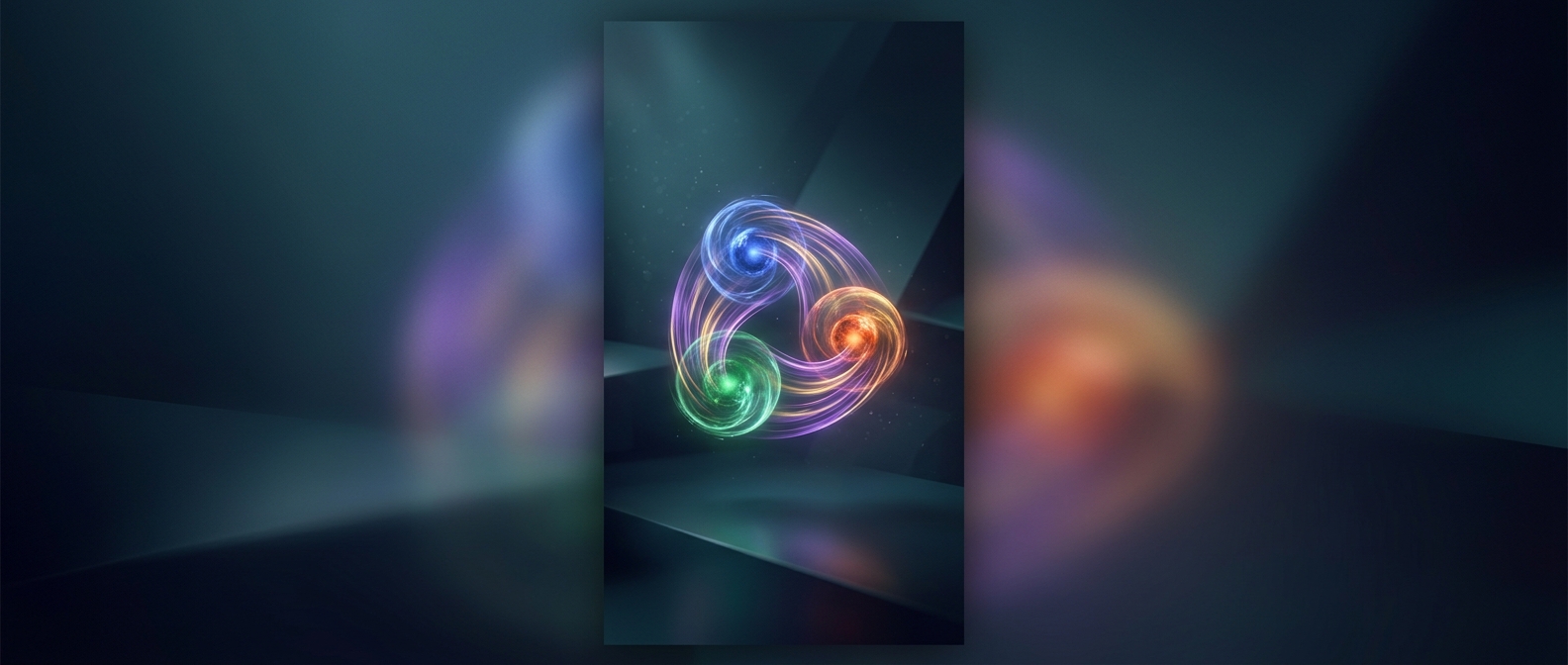
Quarks carry a kind of charge called color charge. Despite the name, it has nothing to do with visible color; it is the label for how quarks interact through the strong force. The force is carried by gluons, which also carry color charge and interact with one another. That self-interaction changes what happens as quarks move apart.
For many familiar forces, such as magnetism, the influence weakens with distance. Between quarks, the strong interaction instead concentrates into a narrow connection often pictured as a flux tube: a thin region of energetic gluon fields linking the particles. Pulling the quarks apart lengthens this tube, adding energy to it rather than spreading the interaction thinly through space.
Why pulling harder makes more particles
Eventually, the energy concentrated in the connection can form a quark and an antiquark. The new particles can pair off with the original quarks, producing separate combinations called hadrons—particles such as protons, neutrons, and mesons. The original quarks have not been freed; the energy of the attempted separation has been converted into additional matter, and the resulting particles still contain quarks bound together by the strong force.
This is why experiments that smash particles together do not reveal lone quarks. Detectors instead register sprays of hadrons, called jets, moving in roughly the directions the energetic quarks would have taken. The quarks’ motion leaves a measurable pattern, even though the quarks themselves never arrive at the detector alone.
A rule with an important limit
Quarks are confined inside hadrons under ordinary conditions, but the strong force is not equally intense at every distance. At extremely short distances, quarks interact more weakly—a behavior known as asymptotic freedom. That helps explain why physicists can treat quarks as nearly free during some high-energy collisions, even though they cannot isolate one afterward. The collision can briefly probe a quark’s motion; the aftermath turns that motion into a crowd of bound particles.