A border runs through the Haskell Library
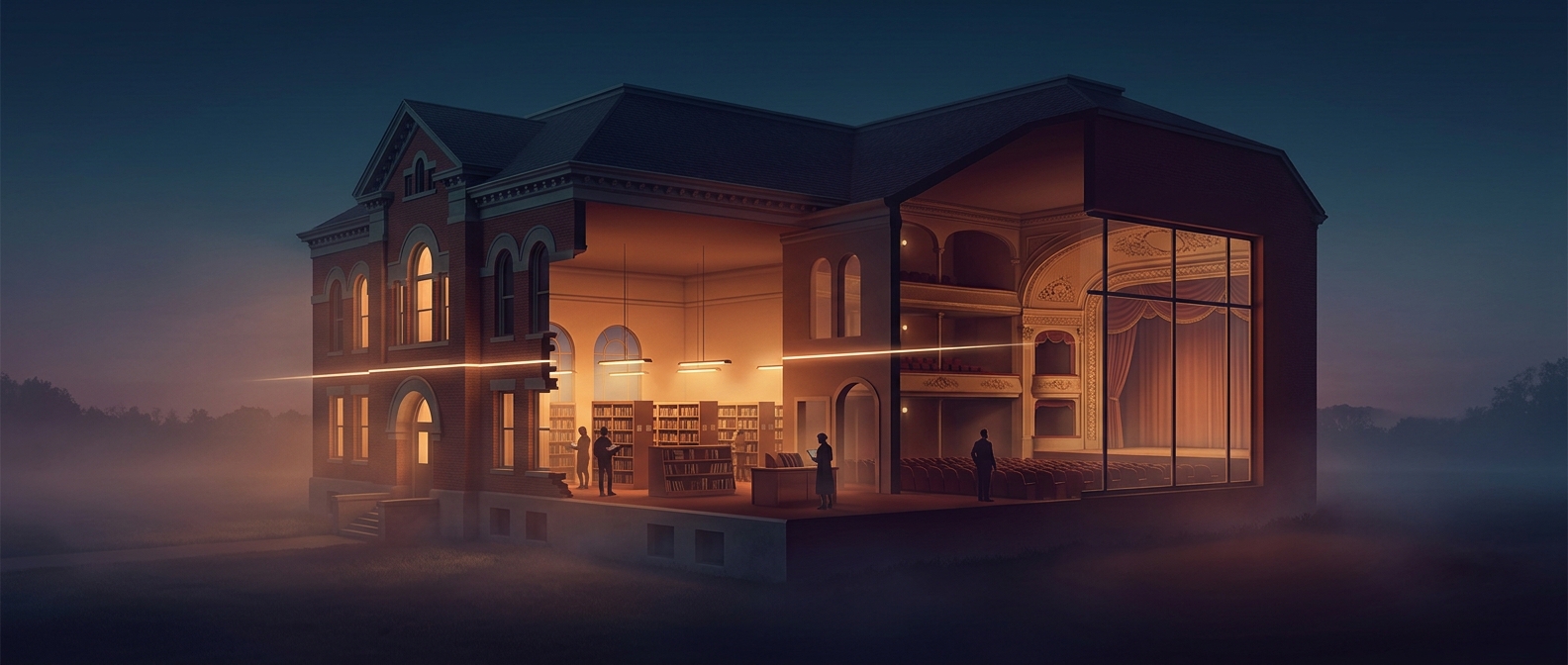
At the Haskell Free Library and Opera House, the international boundary is not outside the building or behind a nearby sign. It passes through the structure itself, leaving the books on one side and the reading area on the other. The library stands in Derby Line, Vermont, and Stanstead, Quebec, where the U.S.–Canada border cuts through the adjoining communities.
That line is a legal boundary, not a wall. Inside the library, a dark stripe marks where it crosses the floor, making an abstract map line part of an ordinary visit: a reader can browse on one side and sit down on the other.
Built to join neighboring communities
The building opened in 1904 as both a library and an opera house. Its unusual placement made it a shared civic space for people living on either side of the border. Rather than treating the boundary as a reason to keep the communities apart, the building put books, performances, and public gathering under one roof.
The result is an architectural oddity with a practical purpose. A library needs shelves and places to read; an opera house needs a stage and an audience. Here, those familiar parts of public life occupy a building that also makes the border visible—and, for a few steps, puts it underfoot.
The line is part of the experience
The marked boundary can make the building feel like a place where crossing countries is effortless. But the stripe is a visible reminder of a real international border, not a substitute for border procedures. What makes the library memorable is the contrast: a political line divides the room, while the institution’s everyday use brings the surrounding communities together.