How a klystron turns electron bunches into radio waves
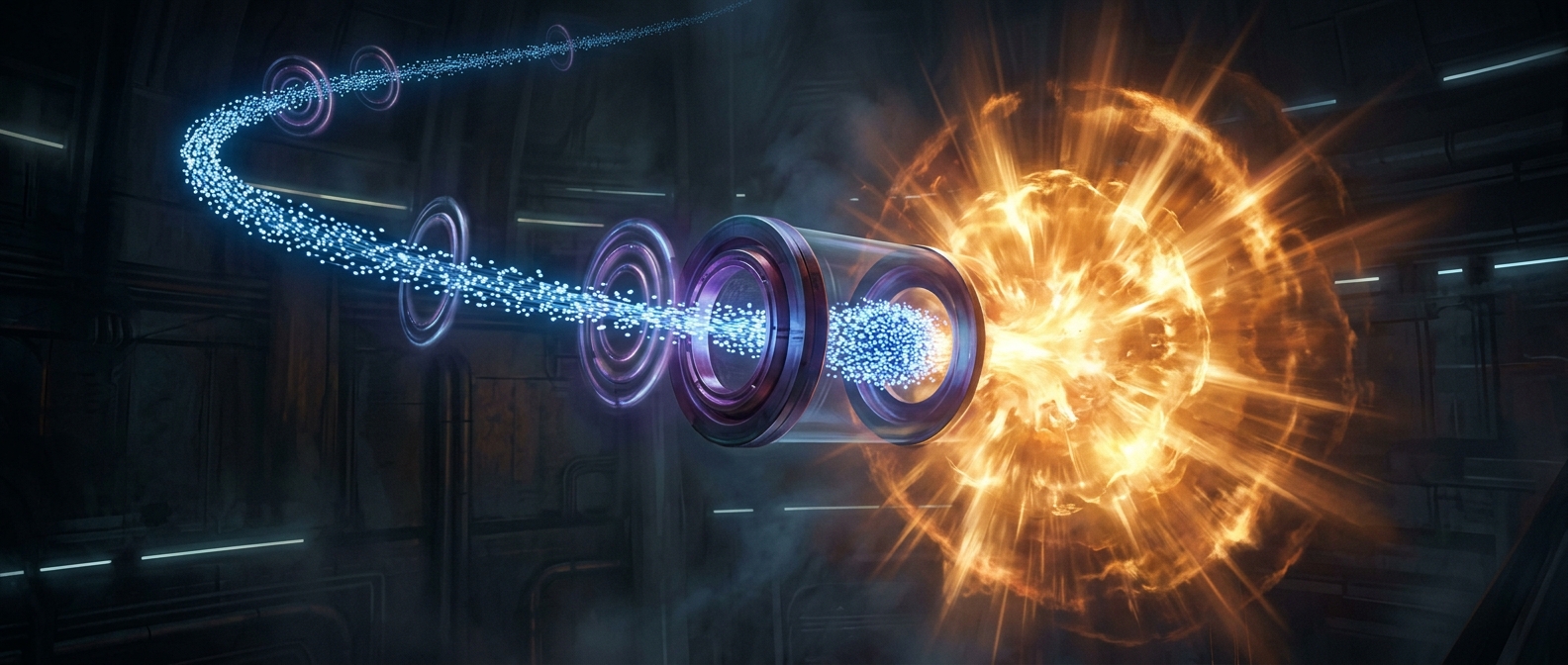
A klystron starts with an electron gun that sends a narrow stream of electrons through a vacuum. The stream enters a buncher cavity, a metal chamber where an alternating electric field speeds up some electrons and slows down others. At first, the electrons are spaced fairly evenly; farther along, the faster ones catch up with the slower ones, gathering into compact bunches.
The electrons are not piling up against an obstacle. The “traffic jam” is a pattern of changing spacing: groups of electrons arrive together, separated by gaps.
Turning motion into microwave power
Those bunches pass through another cavity, tuned to the radio frequency the device is meant to produce. As each bunch moves through, its electric field pushes electrons in the cavity’s walls back and forth. That motion builds a radio-frequency signal—often in the microwave range.
The exchange takes energy from the moving electrons. They leave the output region slower than they entered, while the cavity’s oscillating field grows strong enough to feed a transmitter. In this way, the klystron converts the stream’s organized kinetic energy into concentrated radio-frequency power.
Why the bunching matters for radar
A radar transmitter needs pulses of radio energy strong enough to travel outward, reflect from objects, and return as faint echoes. Klystrons can supply high-power microwave pulses at stable frequencies, making them useful in some radar systems. The essential trick is timing: the cavities shape a steady electron stream into bunches, then draw energy from those bunches at the desired frequency.
The striking part is that the radio wave is not simply emitted by electrons racing through empty space. The device first choreographs their arrival, then uses their motion to drive an electromagnetic oscillation in a metal cavity.