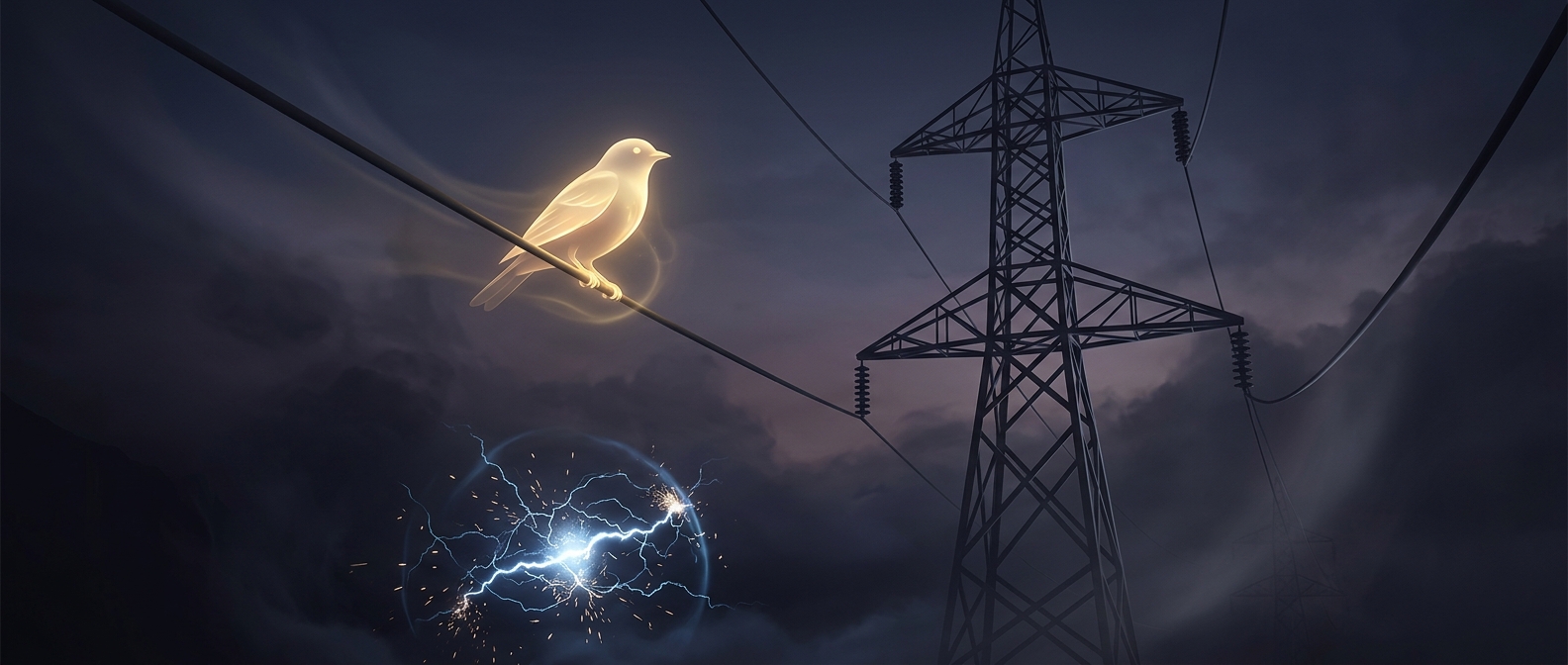
A bird perched on one wire is not bridging a circuit
Electric current flows when charges have a continuous path and a voltage difference pushes them along it. A bird sitting with both feet on the same power line touches two points that are almost at the same electrical potential—the electrical equivalent of height. With little voltage difference between its feet, there is little current driven through its body.
The wire itself carries current, but that does not mean everything touching it gets a dangerous current. The important question is whether the bird connects two places at different voltages. Its body is not a useful route for current when both contact points are effectively at the same voltage.
What changes the risk
The bird could be shocked if it touched another wire at a different voltage, or a grounded part of a pole, while still touching the energized line. Then its body would bridge the two points, creating a path for current through it. The same risk can arise if a bird’s wings or other body parts span conductors with different voltages.
That is why utility equipment is arranged to keep energized parts separated and why workers use specialized protective methods when dealing with live lines. A bird perched calmly on a single wire has not found a magical immunity to electricity; it is simply touching only one electrical level. The danger appears when its body connects that line to something at another one.