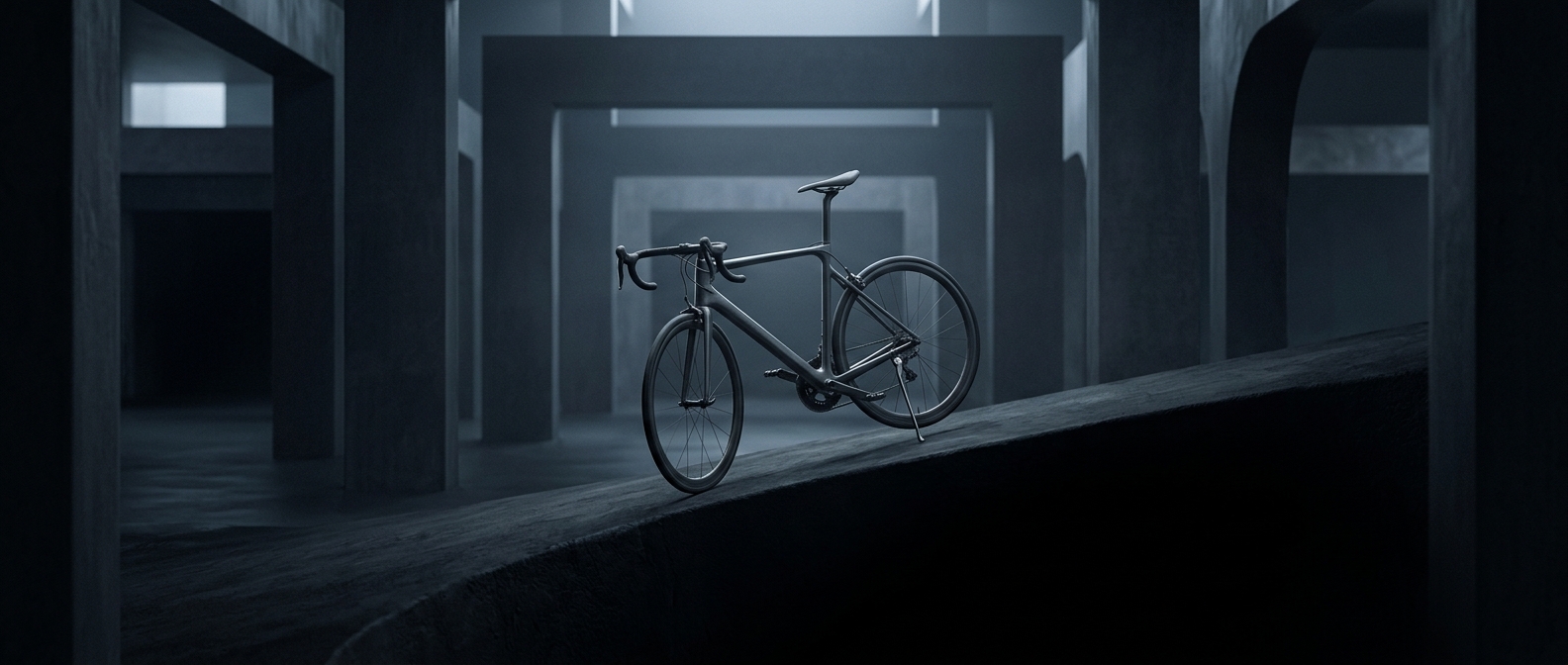
Why a parked bike leans instead of standing straight
A bicycle kickstand is not a rigid third wheel. It supports the frame at one small point, while the two tires touch the ground elsewhere. Those three contacts form a triangle, and the bike stays upright only while its center of mass—the point where its weight effectively acts—falls within that triangle.
The lean is what makes this arrangement work. It shifts the bike’s center of mass sideways toward the stand, so the stand can push upward against the frame while the tires complete the support. Park the bike nearly vertical, and its weight may sit outside the narrow triangle; tip it too far the other way, and the center of mass can pass beyond the stand’s support as well.
Why small changes can topple a bike
The triangle is narrow, so the margin for error is small. A slope, a turned front wheel, or a heavy bag on one side can shift where the weight acts or change the tire contact points. If the center of mass moves beyond the support area, gravity creates a turning force that pulls the bike farther over rather than restoring it.
That is why kickstand length matters: it sets the resting angle. A stand that is too short can make the bike lean so far that it becomes unstable; one that is too long may leave it nearly upright, with too little sideways shift for the stand to support it securely. The familiar slant is not a flaw in the design—it is the narrow balance that lets two wheels and one stand hold a bicycle still.