The line changed what a factory could make
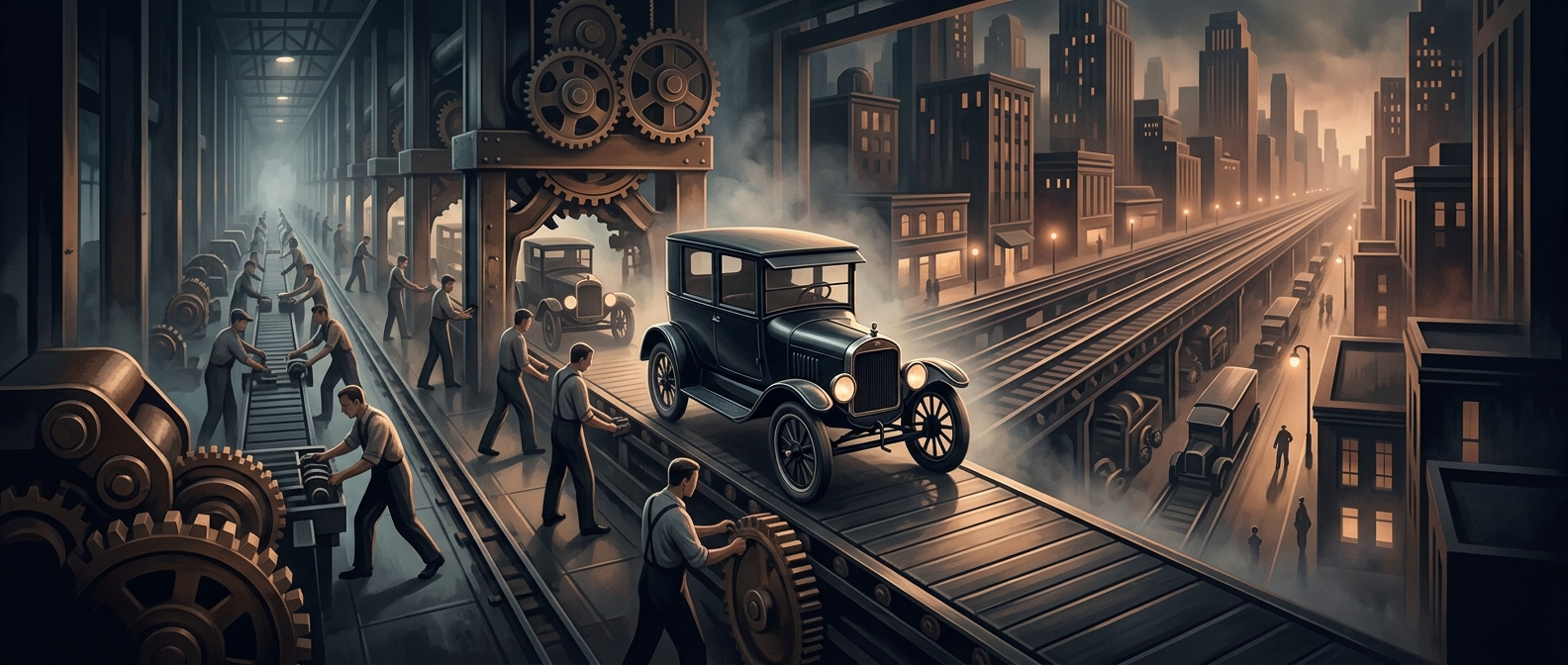
Before Ford’s moving assembly line, workers often built much of a car around a stationary chassis, carrying tools and parts to it. Ford reorganized the work so the chassis moved past stations, where each worker performed a narrower, repeated task. That cut the time lost walking, searching for parts, and waiting for earlier jobs to finish. Standardized components made the sequence workable: a part assembled at one station had to fit the next car just as reliably as the last.
The line also changed the worker’s relationship to time. Instead of setting the pace of a whole craft job, each person had to keep up with the flow of the production system. A delay at one station could slow the line behind it, so managers had a strong incentive to coordinate supplies and tasks closely.
Lower costs reached beyond the factory
Producing cars more quickly and in larger quantities helped Ford lower the Model T’s price over time. That did not make car ownership universal, but it widened the pool of people who could consider buying one. The shift mattered because a car was not just a faster way to make an existing trip: it made a longer distance between home, work, stores, and services more manageable.
As driving became more practical, daily schedules could be planned around travel by car rather than only around walking distance or nearby transit. The commute became a regular obligation, and places that had once felt far apart could be linked in a single day. In that way, the assembly line’s effects traveled outward: a factory method for keeping cars moving helped make movement a routine part of ordinary life.