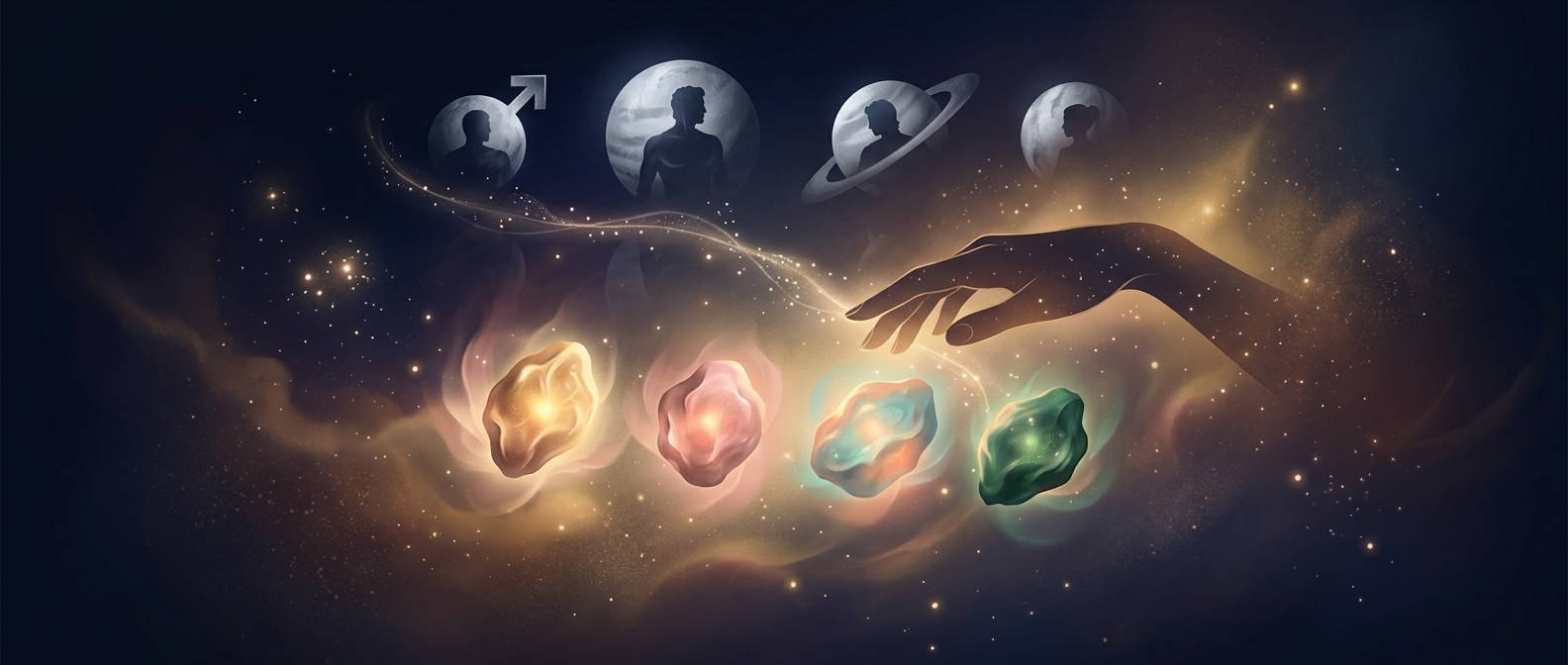
Why asteroids entered the astrological chart
Ceres, Pallas, Juno, and Vesta were not new discoveries of the 1970s: astronomers had identified them in the early 19th century. What changed was how some astrologers used them. Feminist astrologers began bringing these small Solar System bodies into birth-chart interpretation, treating their namesakes in Roman mythology as symbols that could broaden astrology’s account of women’s lives.
That move addressed a limit in the traditional planetary cast. Venus and the Moon could represent feminine themes, but they were only two figures, each carrying a narrow set of associations. Adding four more offered a vocabulary for qualities that did not fit neatly into romance, beauty, or motherhood.
Four figures, four kinds of symbolism
In this astrological approach, the asteroids are read as interpretive symbols, not as forces shown to cause personality or events. Their meanings draw on the myths attached to their names: Ceres is associated with care, nourishment, and separation; Pallas, with intelligence and strategy; Juno, with commitment and partnership; and Vesta, with focus, service, or devotion.
A chart reader might use their positions to ask where these themes appear in a person’s life. The point was not simply to label each asteroid “female,” but to make room for different forms of agency and experience. A woman could be understood as strategic or devoted, for example, rather than represented only through relationships or emotional life.
A change in the questions astrologers could ask
The asteroids’ importance was therefore largely cultural and interpretive: they expanded the symbolic cast available to astrologers. Their inclusion also reflected a broader effort to examine whose stories a tradition treats as universal. Instead of asking only how Venus or the Moon describes a chart, readers could ask what care, ambition, commitment, or concentrated purpose might look like on its own terms.