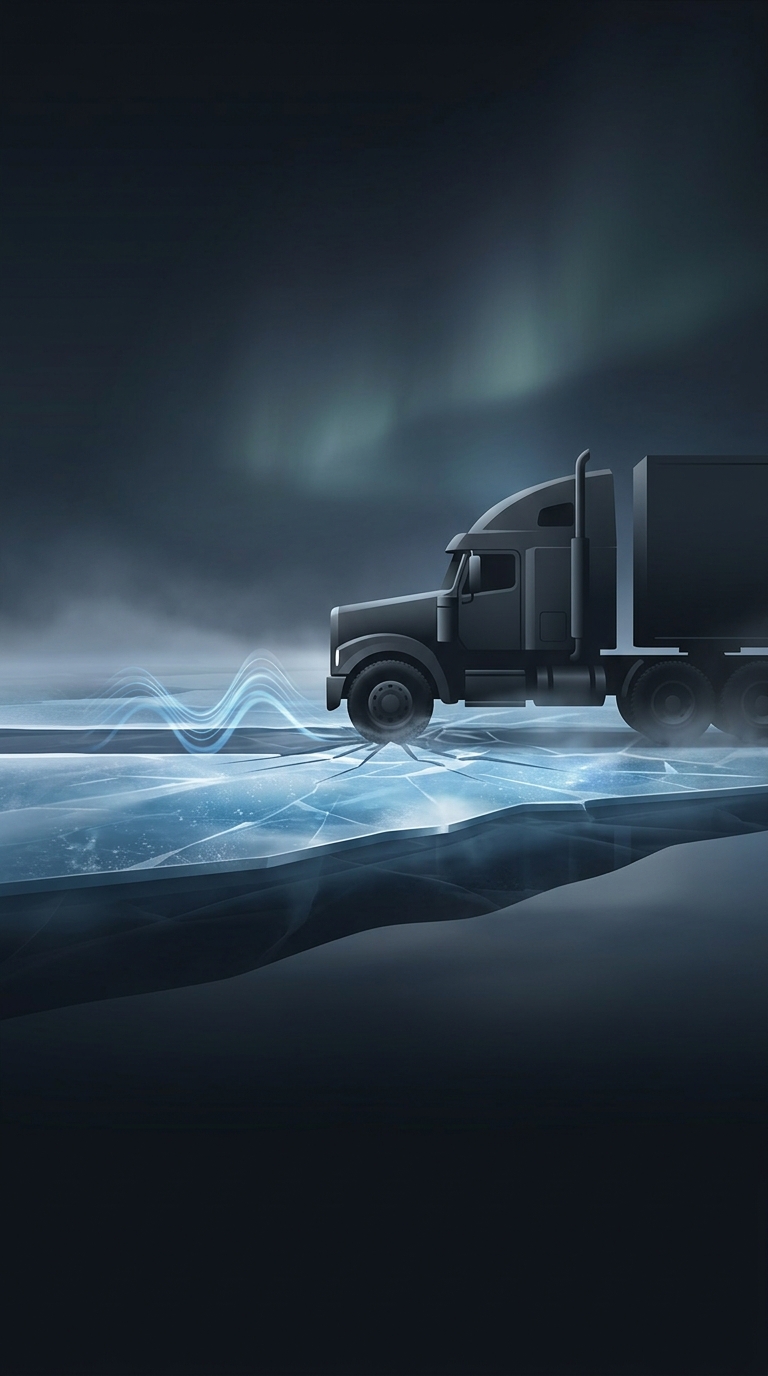
A Moving Truck Can Make Ice Flex Like a Bridge
An ice road is not simply a frozen surface. The ice floats on water, so a heavy truck presses it downward and pushes water aside. As the truck moves, it creates a wave beneath the ice while the sheet bends and rebounds under its weight.
The danger depends not only on how much the truck weighs but also on how its motion interacts with that wave. At certain speeds, the wave can keep pace with the vehicle, concentrating the bending instead of letting the disturbance spread away. Repeated or excessive flexing can enlarge cracks and threaten the route. This is why drivers must obey controlled speed limits rather than assume that slower is always safer: the permitted speed is set to reduce the risk of damaging the ice.
The Road Has to Be Managed, Not Just Crossed
Crews assess ice conditions and manage how vehicles use the route, including speed and spacing. Those controls matter because one truck’s load affects a broad area of floating ice, and the surface can vary along a road. A route that supports traffic under one set of conditions cannot be treated as equally safe everywhere or indefinitely.
That makes an ice road a temporary piece of transport infrastructure. Its usefulness depends on cold weather building and maintaining a sufficiently strong surface, and its operating window closes as conditions change. For remote mines, the route can carry bulky supplies that would otherwise be difficult to deliver; the same seasonal dependence means deliveries have to fit within a narrow, weather-governed window.
The striking part is that the truck is not merely crossing a frozen lake: its speed helps determine how the lake responds beneath it. A driver’s controlled pace is part of what keeps the road usable for the next load.