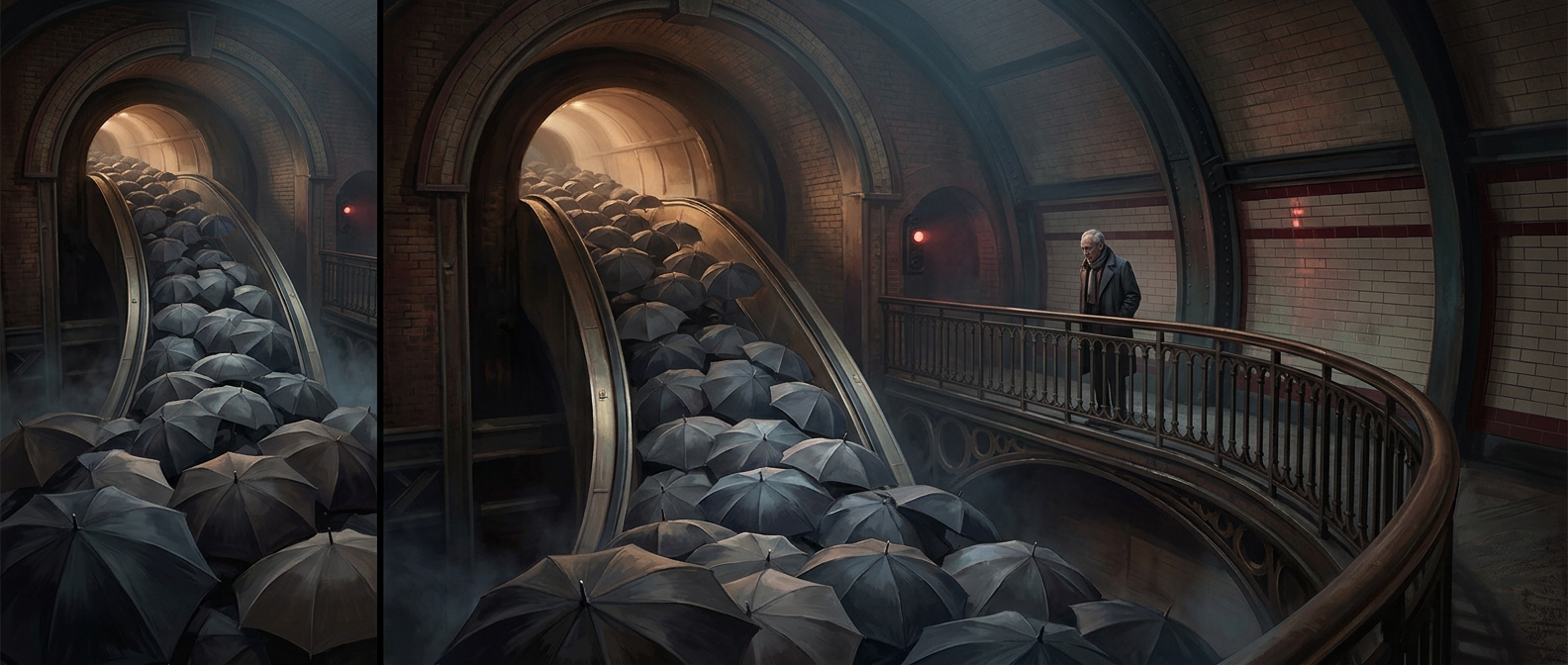
Why umbrellas vanish between the ride and the rain
An umbrella is easy to set down for just a moment: beside a seat, under a café table, or near a door while someone taps a fare card or gathers a bag. In a crowded journey, it can slip out of attention precisely when the weather has begun to clear. At the final stop, passengers are focused on getting off—not checking every place they rested a wet umbrella.
That creates a transport-specific chain of handoffs. An umbrella left on a bus or train may be noticed only after its owner has gone; one left in a café enters a different lost-property system. Each item has to be matched to the right place and time before it can find its way back.
The problem with a pile of black umbrellas
A wallet or phone may have distinctive details. Many umbrellas do not. If several look alike, “a black umbrella” is too broad to establish which one belongs to a claimant. A colored handle, a damaged rib, a pattern inside the canopy, or the vehicle and journey where it was left can make the difference.
That is why the most useful clue is often not the umbrella’s color but its small irregularity—the feature its owner barely noticed while carrying it. In a lost-property office, a mass of nearly identical umbrellas turns a simple forgotten object into a matching problem.