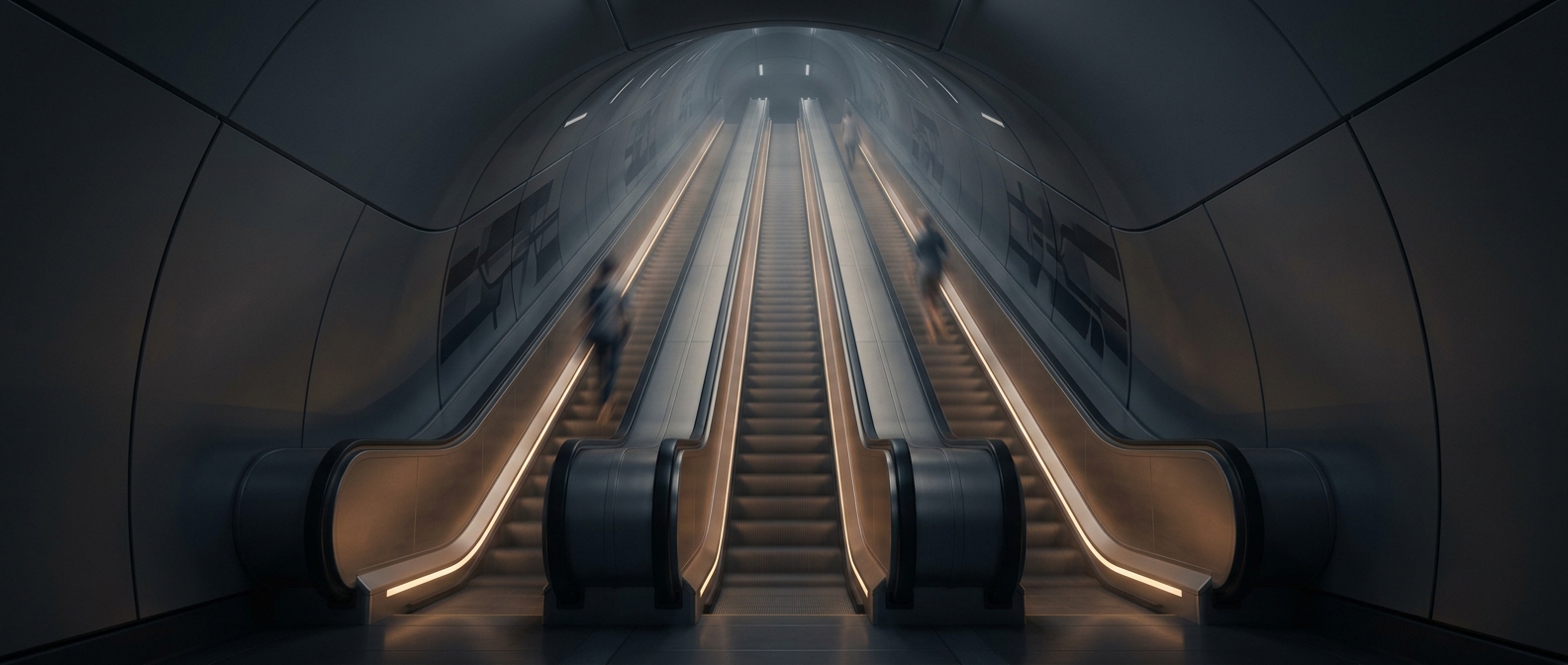
How an escalator keeps its steps coming
An escalator is a loop of linked steps pulled by a motor-driven chain. At the top and bottom, each step’s wheels follow curved tracks that guide it beneath the visible staircase, around the end, and back into position. The steps stay level as they travel along the sloped section, then flatten into a landing so riders can step off onto solid floor.
Because the loop keeps moving, riders do not have to wait for a car to arrive, fill, and depart. People can enter one after another, so the flow is spread across time rather than released in a single burst. That is especially useful at places such as stations, where crowds need to move between levels continuously.
Steady flow comes with a design tradeoff
An escalator cannot carry an unlimited crowd: its capacity depends on how quickly steps move and how many riders use each step. It also occupies a permanent route and runs even when few people are traveling. A lift, by contrast, can serve destinations vertically and pause between trips, but its passengers arrive in batches and may have to wait for the next car.
The escalator’s advantage is not that it eliminates delay altogether. It replaces the wait for a vehicle with a moving queue: while one person steps off, the next steps are already arriving below.