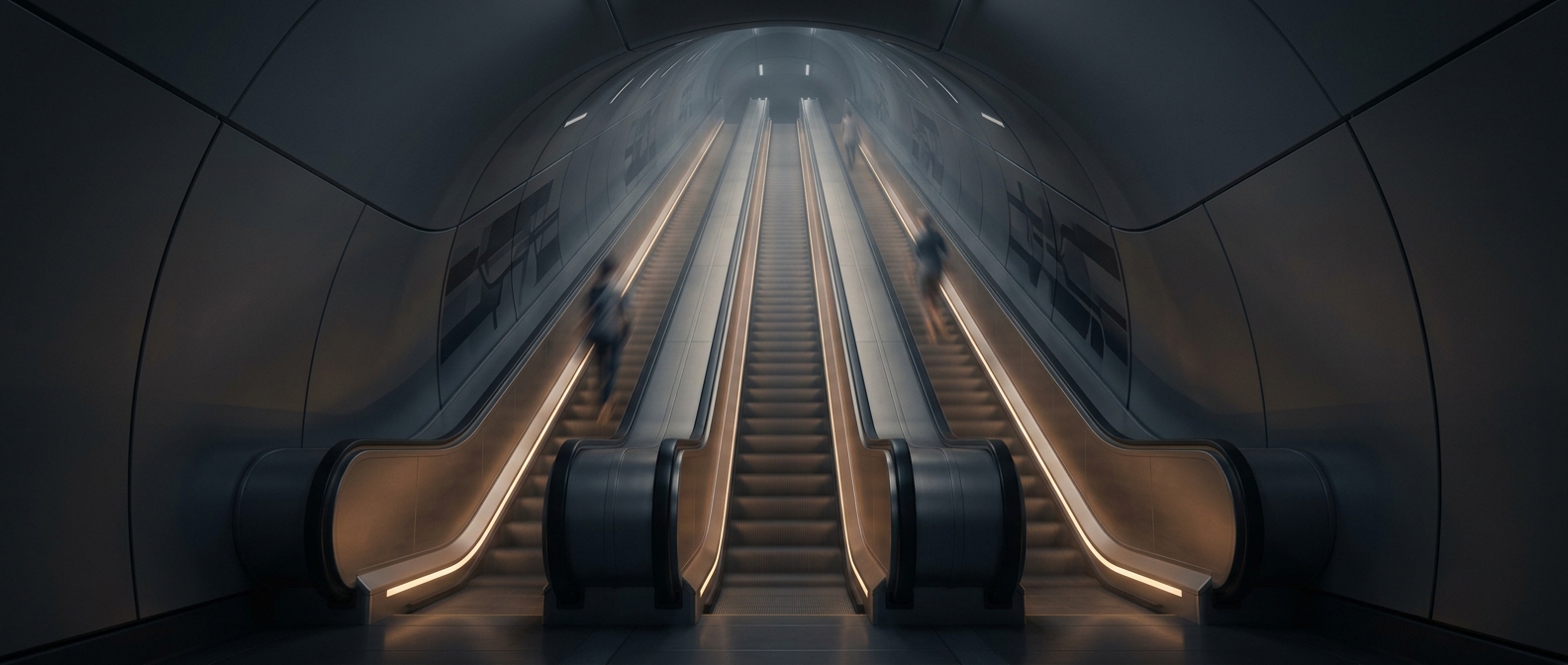
Why an empty escalator lane can mean fewer passengers moved
An escalator is a conveyor with a fixed number of steps passing a landing each minute. Its passenger capacity depends not just on how quickly people travel, but on how many ride each step. When riders stand on both sides, two people can occupy a wide step; when everyone queues on the right to leave the left open, many steps carry only one person.
The walking lane can make the ride feel faster for those who use it, but that is different from moving the most people overall. A few walkers pass standing riders, while the unused space beside those riders carries no one. If the goal is to transport a large crowd, filling both sides generally makes better use of the machine’s width.
Why the walking lane persists
The convention has a practical appeal: people in a hurry can pass without asking others to move. It can also help keep a stream of riders moving through a busy station. But walking does not turn an escalator into a second, faster machine. It uses the same steps, and passing requires people to leave gaps or adjust their pace.
Whether standing on both sides works in practice depends on the crowd and the setting. Riders need room to board and exit without bunching up, and local guidance or conditions may favor keeping a lane clear. The capacity advantage matters most when passengers are willing and able to stand side by side.
The key distinction is between speed for an individual and throughput for the crowd. A clear lane may help one person get ahead; a fully occupied escalator can carry more people on each trip up the slope.