How sunlight made an image on metal
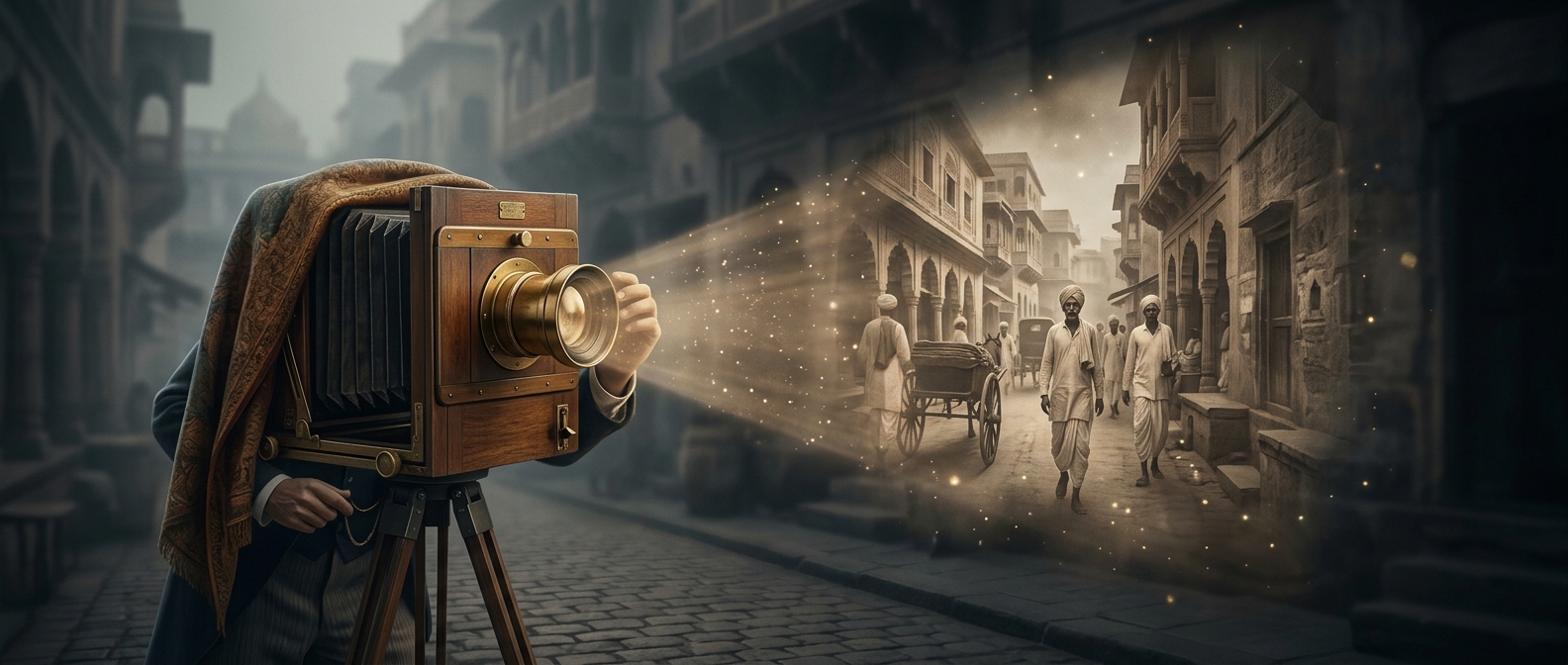
Nicéphore Niépce’s breakthrough was not a camera that captured a fleeting instant. It was a way to make light leave a lasting pattern. He coated a pewter plate with bitumen of Judea, a naturally occurring asphalt-like substance that hardens when exposed to light. After placing the plate in a camera obscura—a dark box that projects an outside scene through a small opening—he let the projected image act on the coating.
The bright parts of the view received more light and became less soluble in the mixture Niépce used to wash the plate. Areas that stayed shaded remained softer and could be removed. What remained was a fixed image: light had not simply passed through the camera but had changed the material itself.
Why the exposure took so long
Bitumen responded to light far more slowly than the photographic chemicals developed later. The plate therefore had to remain in the camera for hours. During that time, sunlight shifted across the scene, illuminating different surfaces in turn. The result was not a crisp record of one moment: architectural details lingered, while shadows and contrasts could seem faint or oddly flattened.
That long exposure also shaped what Niépce could photograph. Buildings and rooftops, which stayed put, were better subjects than people or moving traffic. The image’s ghostlike quality was thus part of the process, not an effect added afterward.
From experiment to photograph
Niépce’s method, which he called heliography, meaning “sun writing,” made an image that endured after the camera was opened. It was a crucial step toward photography, though it was cumbersome and did not produce the easy-to-copy pictures that later methods would make possible.
Its importance lies in that change of purpose: a camera obscura had long projected scenes for artists to trace, but Niépce’s plate preserved a scene through chemistry. The rooftops were recorded not because an artist drew them, but because daylight slowly altered the surface beneath them.