Why The Age of Bronze Looked Suspiciously Real
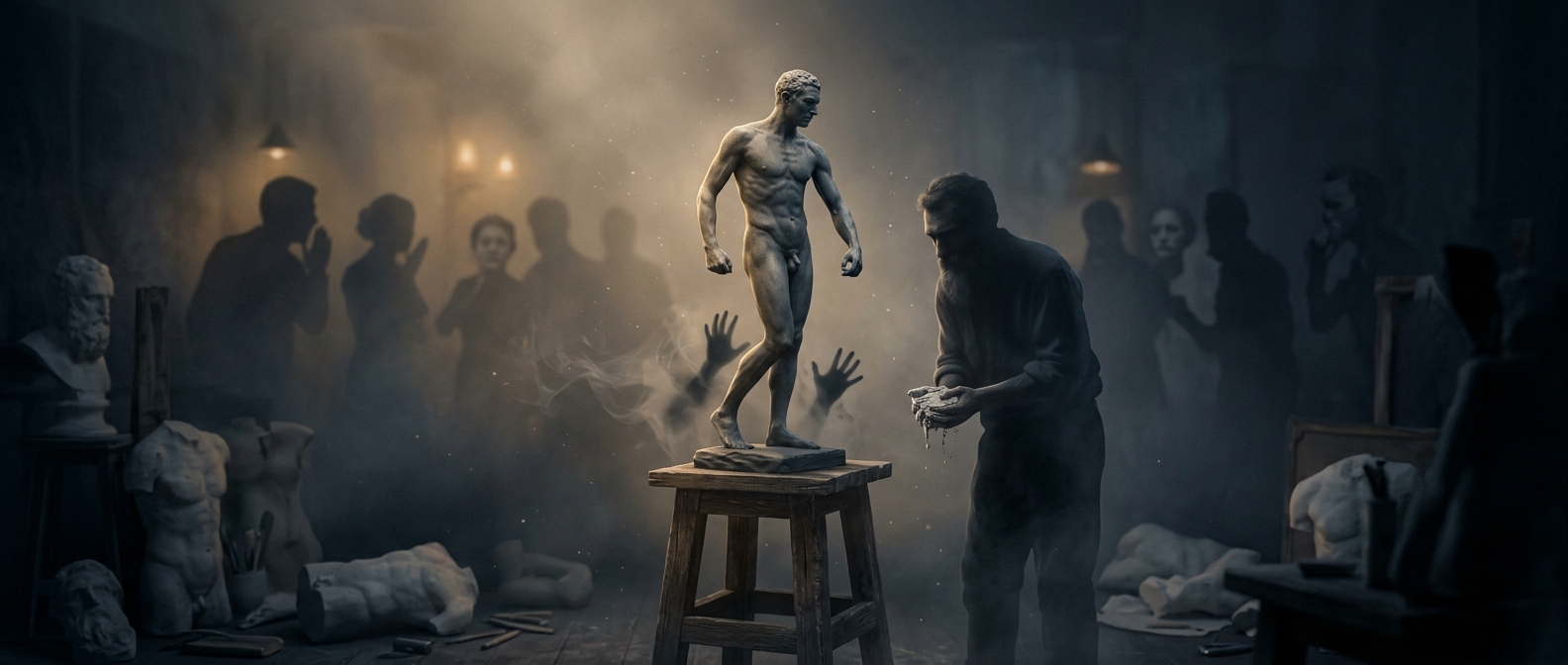
When Auguste Rodin exhibited The Age of Bronze in 1877, its lifelike figure prompted an extraordinary accusation: that he had made it by taking a direct plaster cast of a living man. A direct cast is formed by pressing mold-making material against the body, so it records the model’s surface rather than an artist’s interpretation of it. To critics, the sculpture’s convincing anatomy seemed almost too exact to have been shaped by hand.
The charge mattered because it challenged the source of the work’s artistic merit. If Rodin had simply copied a body mechanically, critics could argue that he had not truly created the figure. The debate was not about whether a model had been involved—sculptors routinely worked from models—but about whether Rodin had transformed what he saw or merely reproduced it.
From a Living Model to a Sculpture
Rodin modeled the figure in clay, building its forms by hand. That was different from making a direct cast of the model, even though both methods could eventually lead to a plaster version and, later, a bronze. The finished surface also carried the sculptor’s choices: how the body stood, how its weight settled, and which details were emphasized.
To answer the accusation, Rodin presented his model, a Belgian soldier named Auguste Neyt, for comparison with the sculpture. The controversy became a test of whether extraordinary realism could still be evidence of artistic skill rather than mechanical copying. Rodin’s career survived the suspicion, and the episode helped make The Age of Bronze famous for a reason beyond its anatomy: it exposed how difficult it can be to distinguish faithful observation from a work that seems almost too lifelike to have been made by hand.