Why a Trombone Can Glide Between Notes
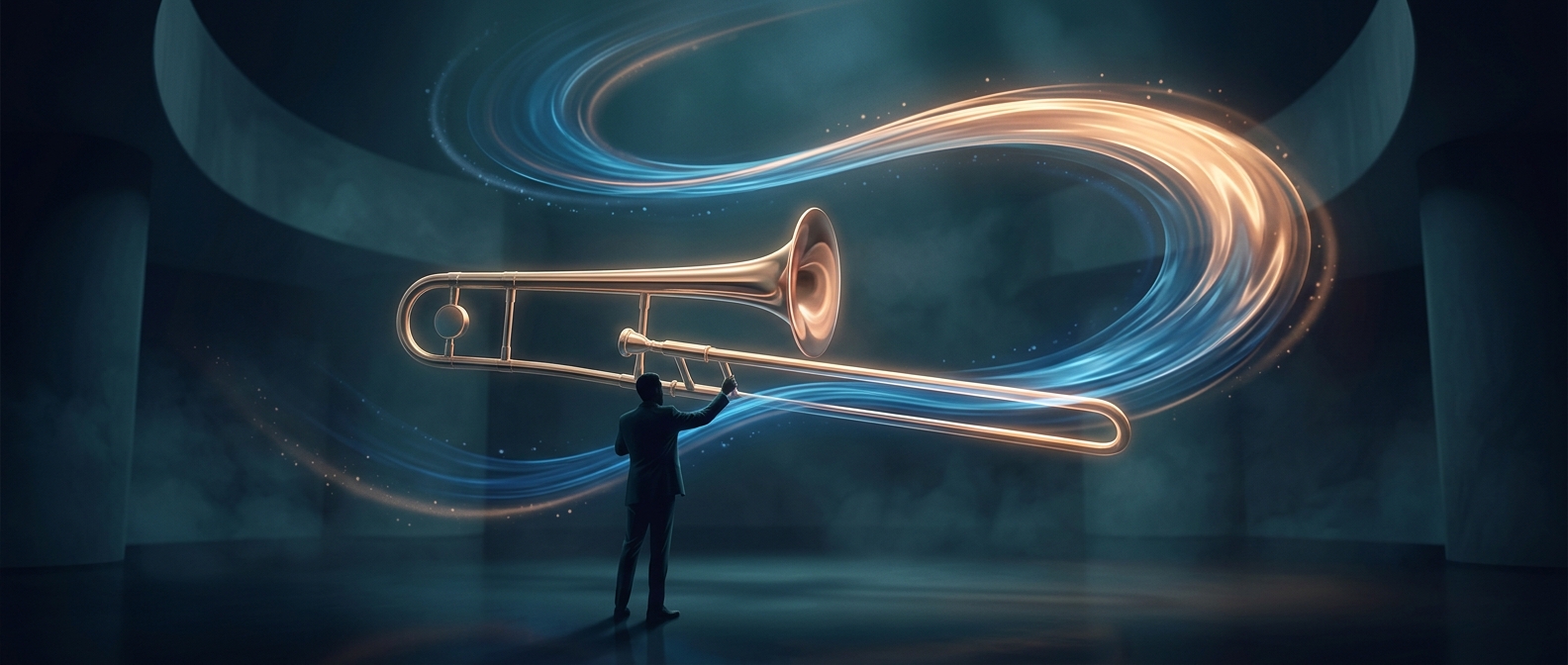
A trombone changes pitch by changing the length of the air column inside its tubing. Its movable slide adds or removes tubing from the instrument’s path: pull it outward and the air column grows, making the note lower; push it inward and the note rises. Unlike valves, which switch among preset tubing paths, the slide can move continuously.
The Slide Has Positions, Not Marked Notes
The slide has seven conventional positions, each corresponding to a different range of tubing length. But those positions are not fixed stops, and there are no keys to lock a player into an exact pitch. The player must learn where each note lies by coordinating arm movement with the sound heard and felt while playing.
That makes accuracy a physical skill as much as a musical one. A player builds muscle memory for the distances between notes, then makes small adjustments because the right placement can vary with the note, the instrument, and the musical setting.
A Continuous Path Changes the Sound
Because the slide can pass through pitches rather than jumping between preset ones, a trombonist can create a glissando—a smooth sweep from one note to another. The same freedom also lets skilled players shape a note’s entrance and tune it subtly in the moment. A valve instrument can imitate some of these effects, but the trombone’s slide makes the change in pitch an immediate, visible movement: the player’s arm traces the sound’s rise or fall.