Why a Four-Faced Shape Became a Creation Symbol
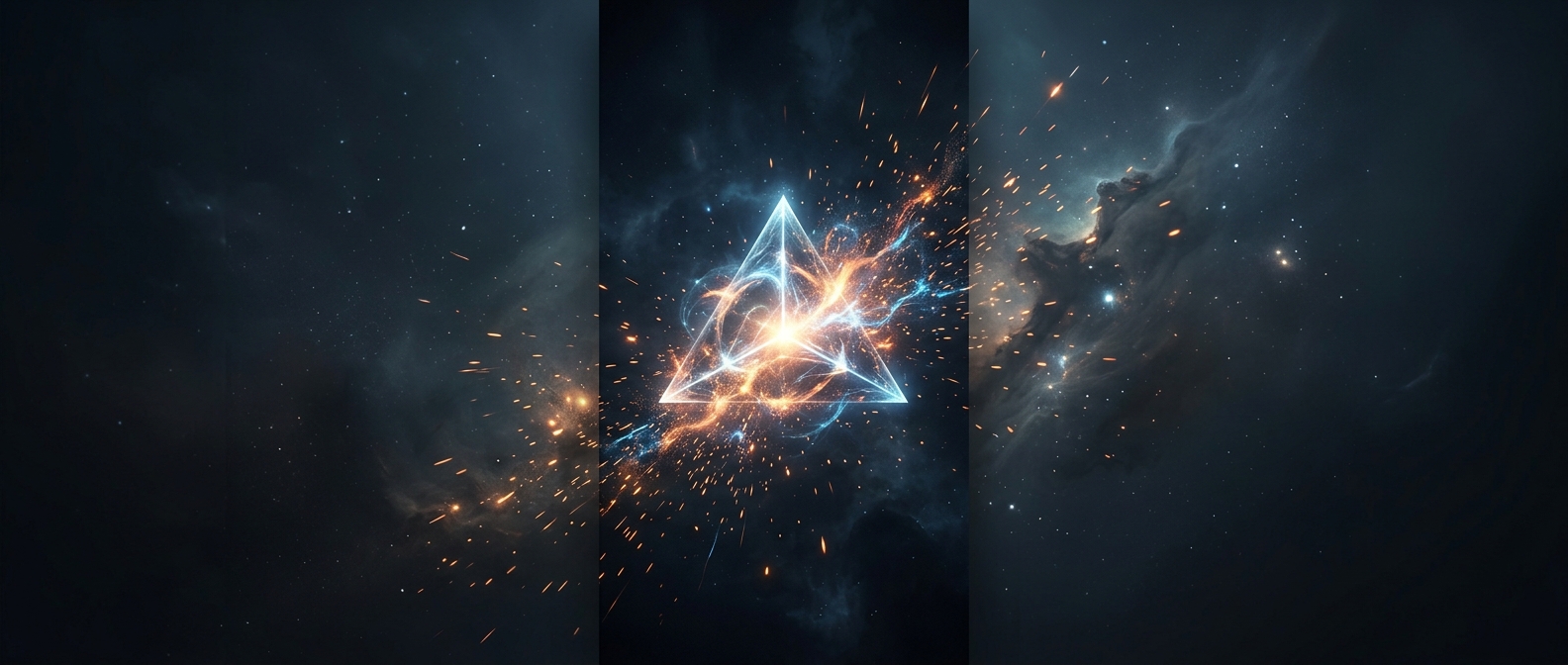
A tetrahedron is built from four triangles joined edge to edge. Its small number of faces gives it a visual sense of beginning: reduce a closed solid any further and there is no three-dimensional enclosure left. The triangles also make a sturdy frame, so the shape can suggest not only a first impulse but the moment something takes form.
That symbolism has a long-standing geometric neighbor. In Plato’s Timaeus, an ancient account of the cosmos, the tetrahedron is associated with fire. Its sharp points and comparatively light, mobile appearance fit the qualities Plato assigned to that element. Later mystical and esoteric interpretations have drawn on the tetrahedron in other ways, treating its simplicity as an image of an originating pattern or creative energy. These meanings vary; there is no single universal doctrine attached to the shape.
From Geometry to Metaphor
The leap from solid to symbol comes from reading physical structure as a picture of an invisible process. A point can stand for potential; joined points become edges, and edges enclose a volume. In that reading, the tetrahedron is a compact emblem of the transition from possibility to a formed world—not a scientific account of how the universe began, but a way to make an abstract idea visible.
Its appeal lies in how much it seems to contain with so little: four faces are enough to turn a handful of lines into a complete space. That makes the tetrahedron a memorable image for creation as the first act of giving form.