Why Levitation Became a Sign of the Otherworldly
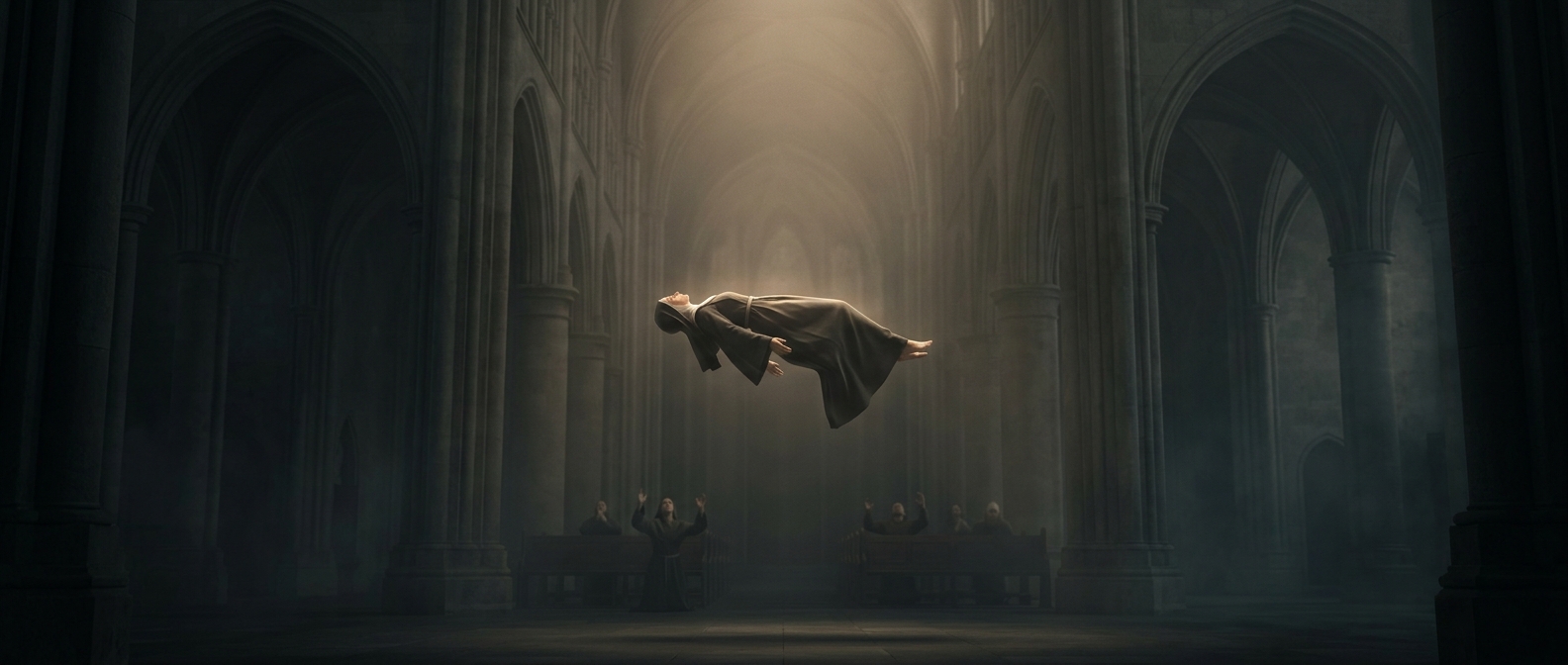
Reports of people rising from the floor appear in accounts of intense religious and paranormal experiences. The image is striking because it turns an invisible claim—contact with a spiritual realm—into something witnesses describe as visible and physical. A body that seems to leave the ground can be understood as crossing a boundary between ordinary life and a sacred or uncanny world.
What the Details Communicate
Descriptions often emphasize small distances: inches above the floor, or, in more dramatic tellings, close to the ceiling. Such details make the event easier to picture and give a story a sense of immediacy. They also shape its meaning. A slight rise suggests a brief interruption of ordinary weight; a much higher ascent suggests a more complete departure from everyday limits.
Accounts of this kind are testimony, not a shared technical record of how a body was supported or measured. That distinction matters: the stories can reveal what witnesses believed an experience meant without settling how it happened. In traditions that treat levitation as spiritual, the reported floating is not merely a spectacle. It can signify unusual holiness, a powerful altered state, or the presence of forces beyond the visible world.
Why the Story Endures
Levitation makes an invisible experience concrete enough to retell. The central image is simple—a person apparently suspended where gravity should pull them down—yet its interpretation depends on the community and the circumstances. That is why the same kind of report can be remembered as a miracle, a paranormal event, or an account whose physical details remain uncertain.