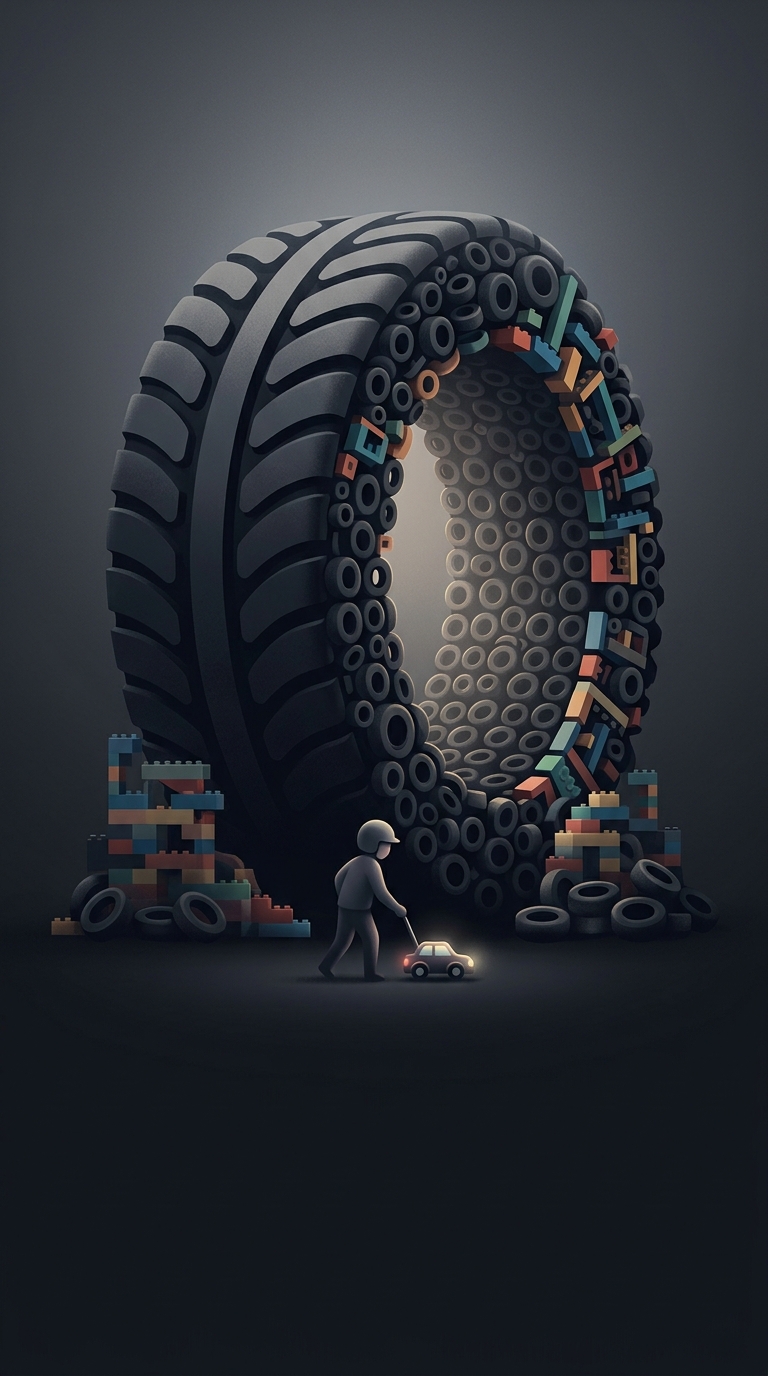
What counts as a tire in LEGO’s tally?
A road tire and a LEGO tire serve the same basic purpose—giving a vehicle a rolling surface—but they are radically different products. The comparison is about the number of individual tires made, not the amount of rubber used, their size, or the value of sales. A tiny tire on a toy car counts as one unit, just as a full-size car tire does.
That counting rule is what makes LEGO’s production startling: millions of small components add up quickly when they are needed across a vast range of toy vehicles and sets.
Small parts, repeated at huge scale
A LEGO tire is a compact molded component designed to fit a particular wheel and roll on a floor or play surface. Many are made from flexible, rubber-like plastic rather than being comparable in material or construction to a road tire. The part must be small enough for a toy, durable through handling, and consistent enough to fit its matching wheel.
Producing large quantities of standardized parts is well suited to molding: material is shaped in a form, then the finished pieces can be made again and again to the same dimensions. The challenge is not building one complicated tire, but reliably making enormous numbers of tiny ones that work with the toys they are designed for.
A different kind of tire empire
The annual total—more than 318 million miniature tires—makes LEGO the world’s largest tire manufacturer by this unit-count measure. It is a playful distinction, but it also reveals how much mass production sits behind a toy vehicle: every little car needs wheels, and every wheel needs a tire that fits.