When a Production Car Runs Into a Track Rule
Drag strips do not judge safety by a car’s badge or by whether it is legal to drive on public roads. They apply equipment requirements to how quickly a vehicle can cover the quarter-mile and, in some cases, how fast it is traveling. The reason is practical: at racing speeds, a driver needs protection if the car crashes or loses control.
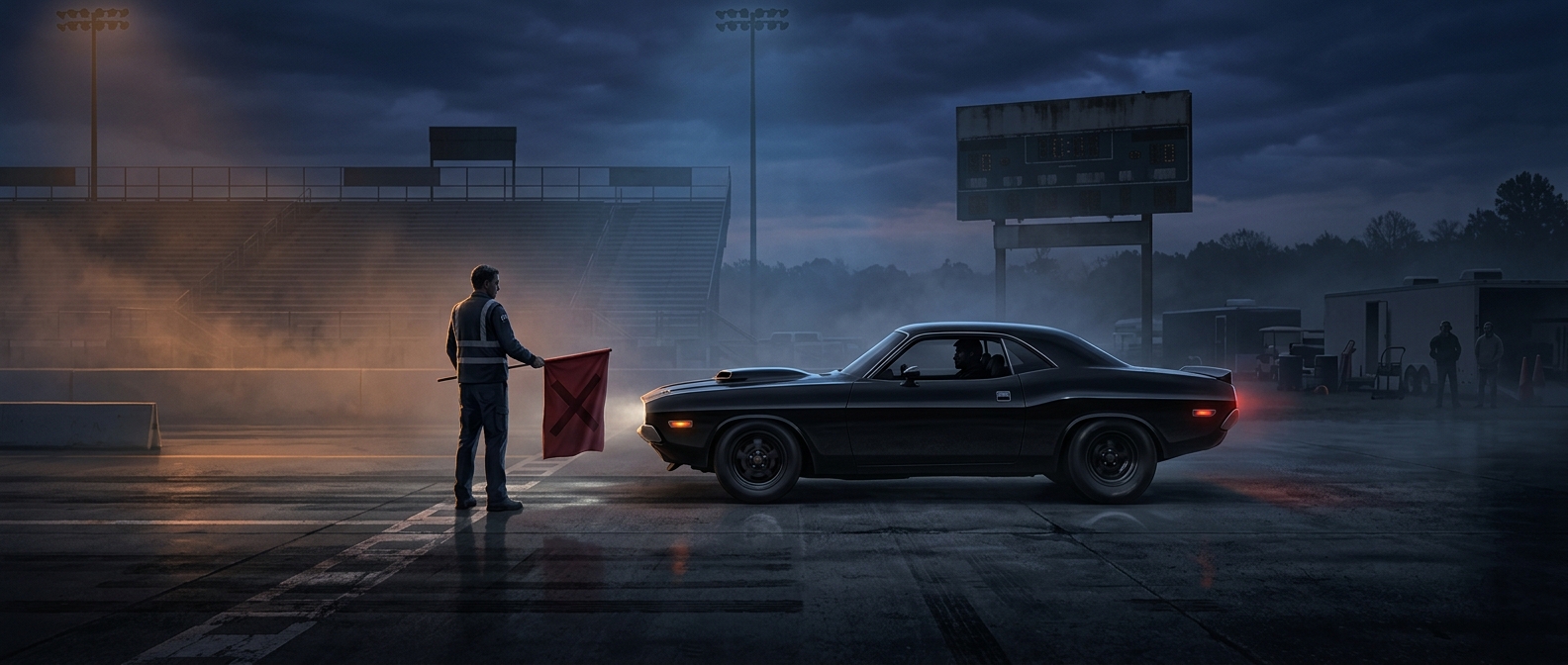
The Challenger SRT Demon crossed a threshold built into those rules. Its factory performance was quick enough to trigger requirements for added safety equipment, including a roll cage—a reinforced structure around the driver that helps protect the passenger compartment in a crash. The production car did not come equipped with the required cage.
Fast Enough to Need More Protection
That created an unusual mismatch. The Demon arrived from the factory capable of a pass that put it on the wrong side of the track’s safety cutoff, but it lacked equipment the rules called for at that level. A car can therefore be road-legal and still be ineligible to make a full-speed run at a sanctioned drag strip in its unmodified form.
The restriction was not a verdict that the Demon was inherently unsafe, nor did it mean the car could never race. It meant the vehicle had to be brought into compliance before it could make runs that triggered the rule. Once modified with the necessary safety equipment, it could meet the track’s requirements.
That is the irony behind the Demon’s reputation: its performance was not merely a selling point. It was also what moved the car into a category where the consequences of a crash—and the protections expected of the driver—were treated differently.