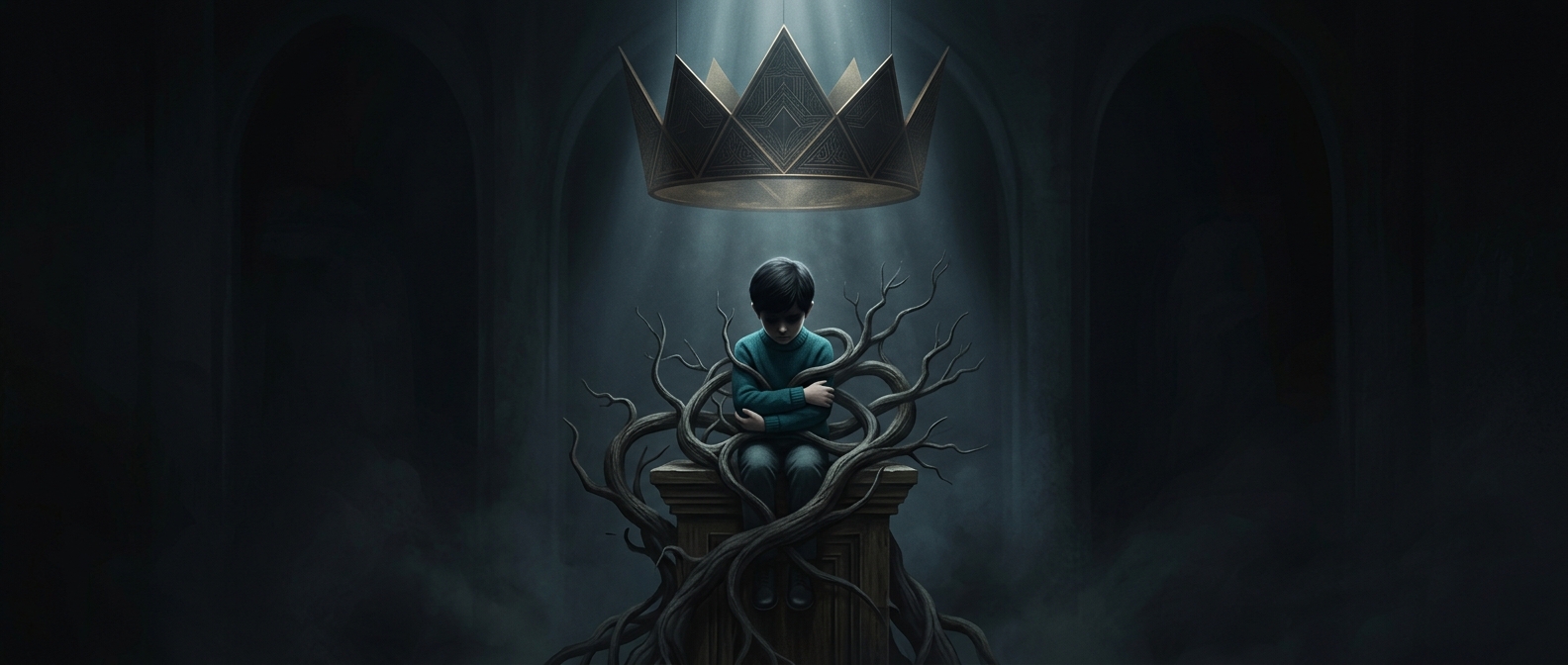
A family triangle in Freud’s theory
Freud used the name Oedipus complex for a conflict he believed arose in early childhood: a boy feels an unconscious attachment to his mother and experiences his father as a competitor for her attention. The name comes from the Greek myth of Oedipus, who unknowingly kills his father and marries his mother. Freud meant the story as a symbolic parallel, not as a claim that children consciously plan adult relationships.
In Freud’s account, the conflict belongs to a stage of psychosexual development, when a child’s feelings about closeness, attention, and authority take on new significance. The father is therefore more than an obstacle. He is also the powerful person the boy wants to resemble and win approval from—a combination Freud saw as emotionally difficult.
From rivalry to identification
Freud proposed that the boy eventually gives up the wish to displace his father and instead identifies with him. In plain terms, identification means taking another person as a model: the child begins to adopt aspects of the father’s behavior and values. Freud believed this shift helped shape the child’s developing sense of right and wrong, which he called the superego.
That makes the theory’s ending part of its central mechanism. The rival is not simply defeated or rejected; he becomes a model through whom the child learns how to behave and understand himself. Freud presented this as a largely unconscious process, not a decision a child could explain in words.
The Oedipus complex became one of Freud’s best-known ideas and a cornerstone of his account of childhood development. It also shows how psychoanalysis interpreted family relationships: ordinary attachments and rivalries could, in Freud’s framework, help form a person’s inner rules and identity.