Build a cube in a new direction
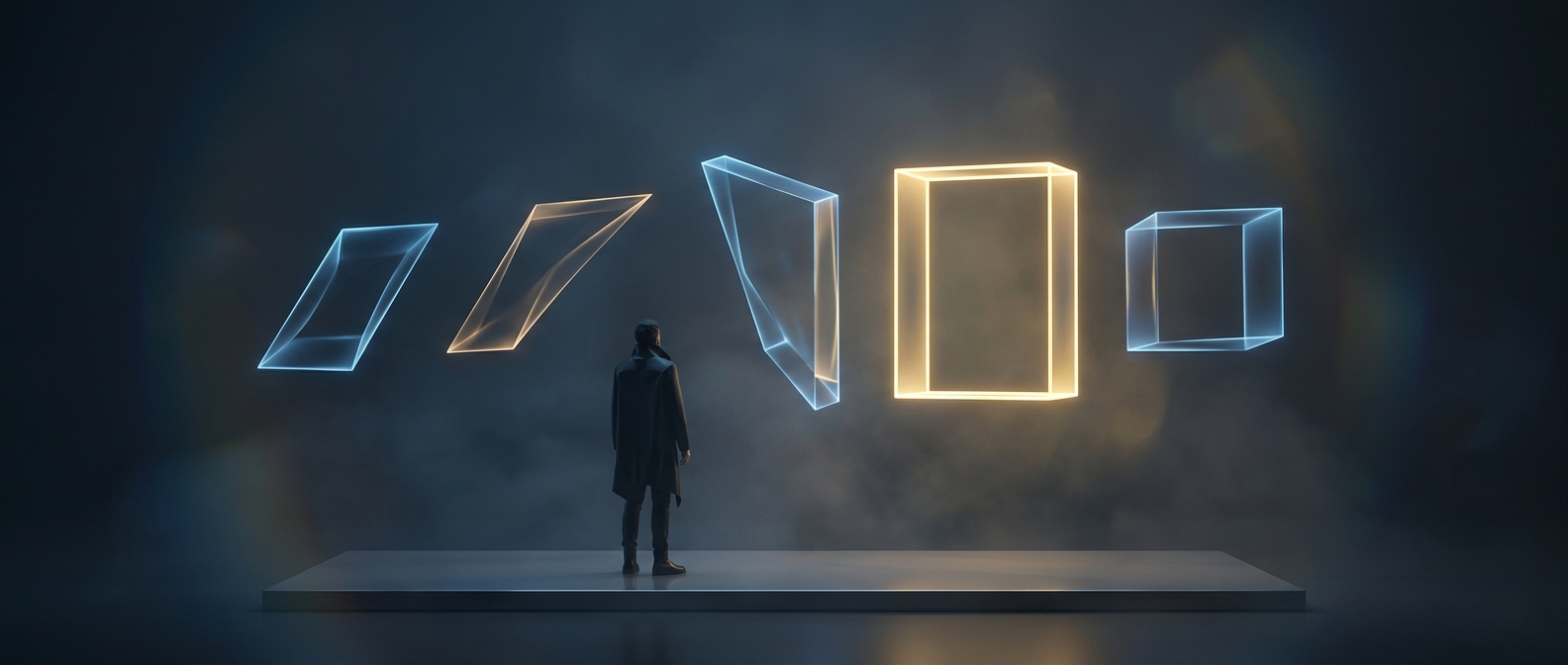
A tesseract can be constructed by repeating the same step used to make a cube. Start with a square and copy it a short distance in a direction perpendicular to its plane; connect corresponding corners, and the result is a cube. Now imagine copying that entire cube in a direction perpendicular to all three directions available in ordinary space, then connecting matching points. That new direction is the fourth spatial dimension.
The construction is mathematical, not a claim that a fourth direction is hidden somewhere in the room. It defines how points and edges relate even though our eyes cannot look along that direction.
Why its shadow looks like boxes
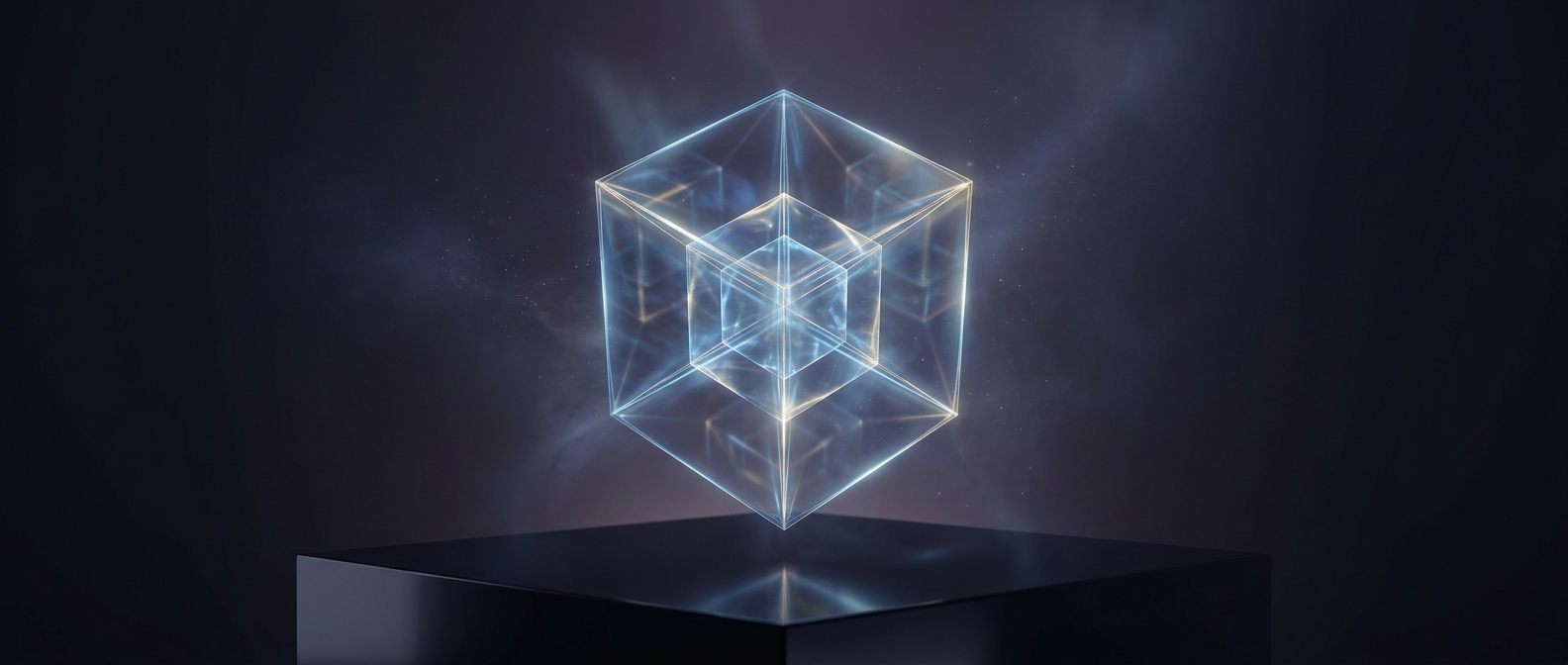
To show a four-dimensional object on a page or screen, you have to map it into fewer dimensions. A familiar analogy is drawing a cube on paper: its three-dimensional depth becomes lines and angles in a flat picture. Projecting a tesseract into three dimensions creates a similar loss of information. The result often looks like a smaller cube inside a larger one, with corresponding corners joined—but that is one projection, not the object’s literal shape.
Just as a cube’s flat drawing can change with the viewing angle, a tesseract’s three-dimensional projection can take different forms. Some edges overlap, and lengths and angles may be distorted, so the image is a guide to connections rather than a faithful view from a possible camera position.
A useful count of its structure
The tesseract has 16 vertices and 32 edges. It is bounded by eight ordinary cubes, just as a cube is bounded by six squares. Those counts describe the object without needing to picture its fourth direction: the nested-box diagram is useful because it preserves some connections, not because it reveals a hidden interior.