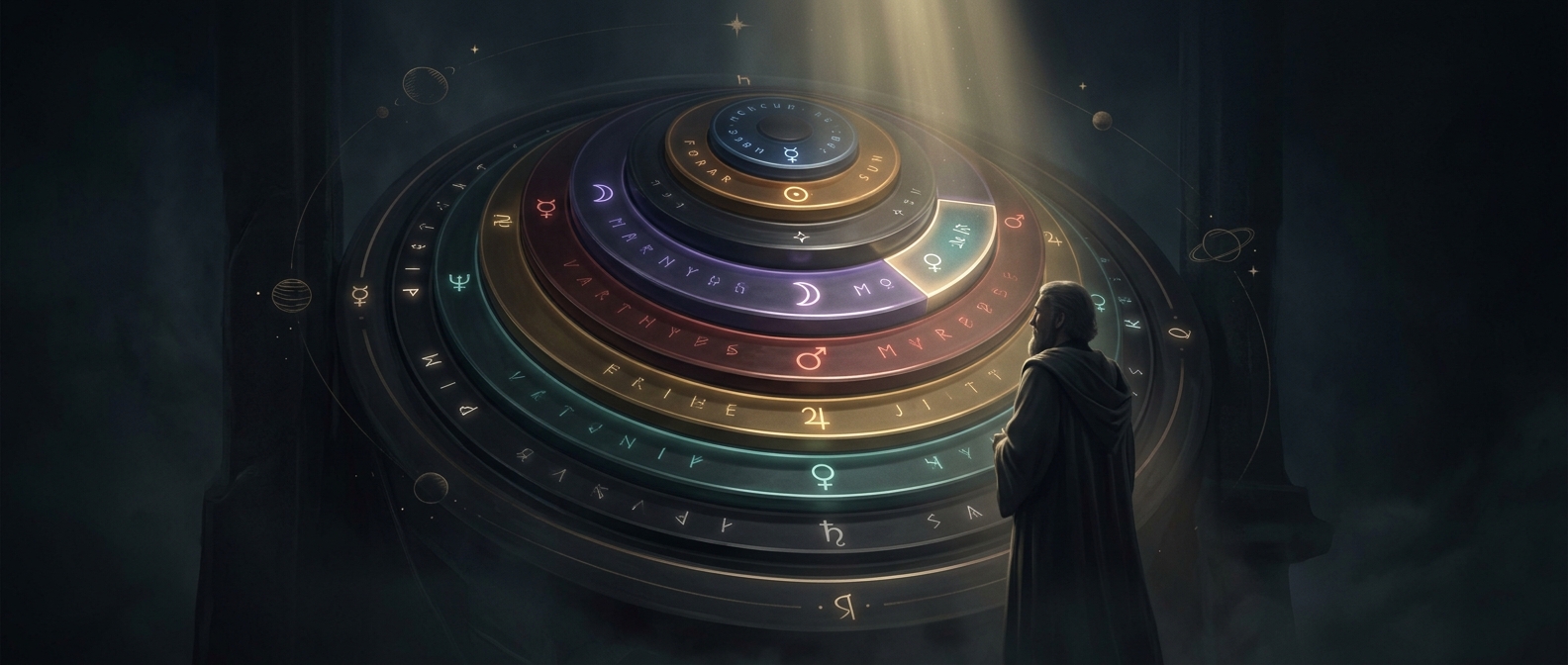
How Firdaria assigns a ruler to each life stage
Firdaria is a timing technique in traditional astrology. Rather than treating every year as astrologically alike, it divides a person’s life into long planetary periods, each linked to a planet in the birth chart. Astrologers interpret the planet as a symbolic emphasis for that stretch of life—not as a force shown to determine what will happen.
The sequence depends on whether the birth chart is considered a day chart or a night chart, a distinction based on whether the Sun was above or below the horizon at birth. The periods also have set lengths. As one ends, the next planet takes its turn, creating a timeline that can extend across much of a person’s life.
A period can have a smaller clock inside it
Many practitioners further divide a major period into shorter subperiods associated with other planets. This creates a layered reading: the main ruler supplies the broad symbolic theme, while the subperiod ruler is used to describe a more specific phase within it. To interpret either layer, an astrologer looks at the planet’s placement and relationships in the birth chart.
That structure is what makes Firdaria feel like an itinerary rather than a series of isolated predictions. The same planet can carry different meanings for different charts, because its astrological condition changes from one chart to another.
A symbolic calendar, not a measured life cycle
Firdaria offers a way to organize experience into recurring periods and interpret them through astrology’s planetary symbolism. Its dates and themes belong to that interpretive tradition; they are not a scientific calendar of personality or events. In practice, the technique’s distinctive move is simple: it asks not only which planet matters in a chart, but when that planet’s period is said to come forward.