The rim acts like a temporary hinge
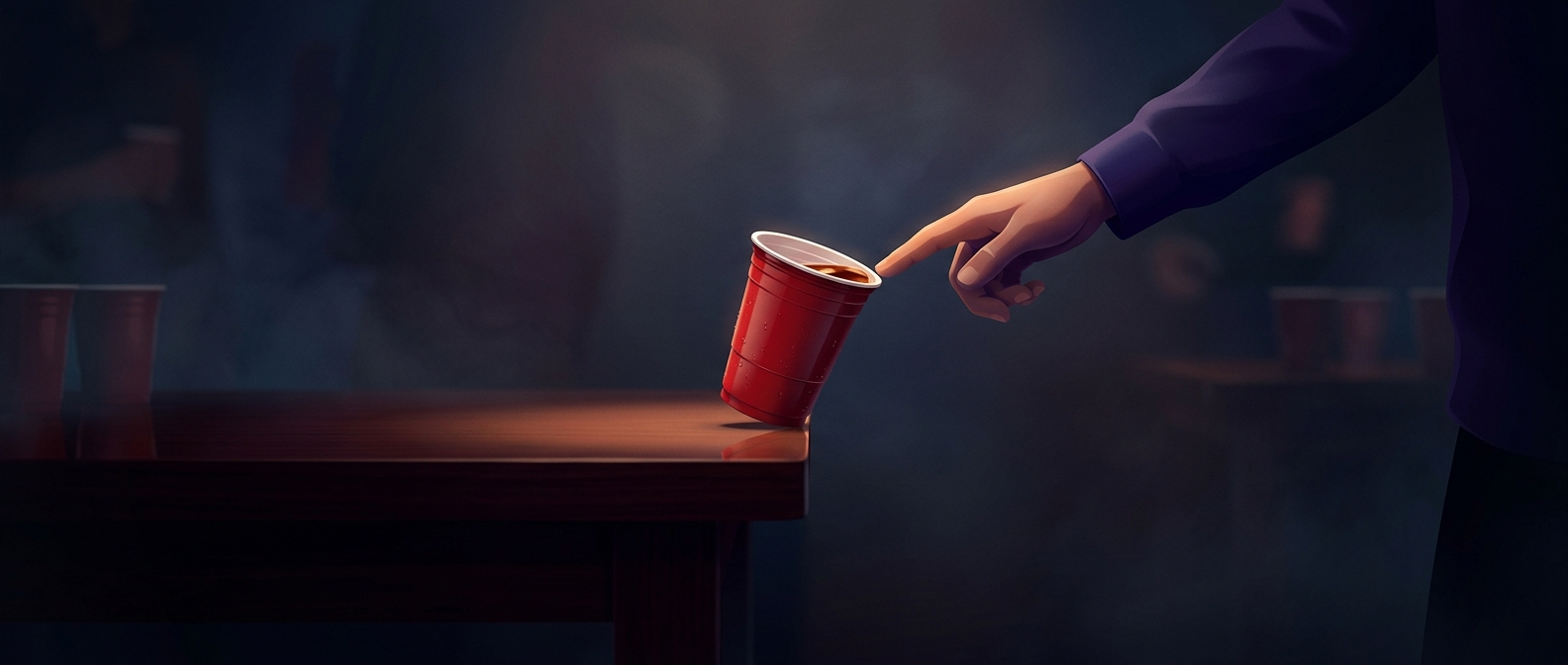
A cup flip looks like a single wrist motion, but the cup’s position on the table sets up the motion before the flick begins. With part of its base beyond the edge, the cup can rock around the point still touching the surface. That contact point acts as a pivot—a temporary turning point—rather than letting the cup slide as one flat object.
The flick pushes the cup upward while also making it rotate. In physics, a push that turns an object around a pivot creates torque. The farther the cup’s weight sits from that pivot, the more turning effect a given push can produce. The overhang therefore gives the player a way to start the spin without needing to sweep the cup across the table.
A clean landing is a timing problem
Once the cup leaves the table, the pivot is gone. The cup keeps rotating through the air, while gravity pulls it downward. To land upright, it must complete roughly half a turn before it reaches the surface. Too little spin leaves it on its side; too much sends it past the landing orientation.
That makes the trick a coordination challenge: the player must give the cup enough lift to stay airborne and the right amount of rotation to turn it over in that time. Small changes in where the cup sits or how sharply the hand flicks can alter both. The satisfying landing is not just a lucky flip—it is a brief match between the cup’s spin and its fall.