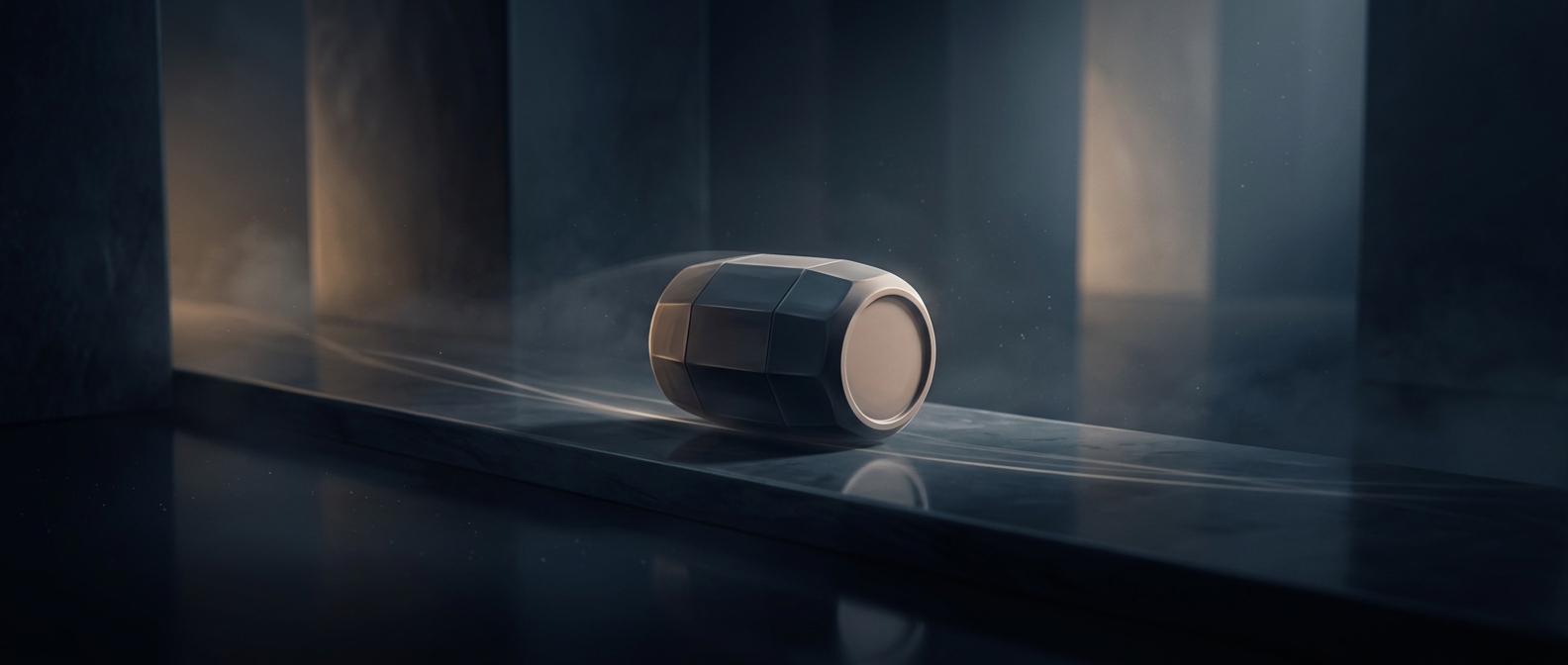
Why a cylinder die has fewer ways to tumble
A cube can tip over in several directions: each of its six faces can become the bottom, and its edges and corners provide many routes between them. A cylinder has a different shape. Its curved wall lets it roll around its lengthwise axis, but the smooth symmetry gives it no distinct edges or corners to redirect that motion. In that sense, its rolling is constrained to one axis.
Shape guides the landing
The cylinder’s flat ends add another possible resting position: it can stop upright on an end rather than on its curved side. The exact chances depend on the die’s proportions, how it is thrown, and where its markings are placed. A cylinder die is therefore not simply a cube with fewer faces; its geometry changes both the paths it can take and the positions in which it can settle.
That matters for play. A cube’s familiar shape offers several discrete face-up results, while a cylindrical die concentrates motion around a narrower set of orientations. The result is a die whose shape makes its behavior—and the limits of its possible outcomes—part of the game’s design.